A smart lock is the device that most changes daily life in a connected home and the one where a poor choice has the most consequences. It is also the category where the marketing focuses hardest on convenience and least on the two things that matter: whether it is physically secure, and whether it opens when everything else has failed.
Here is how to evaluate one.
The four types, and which suits your door
What is possible depends almost entirely on the door you have.
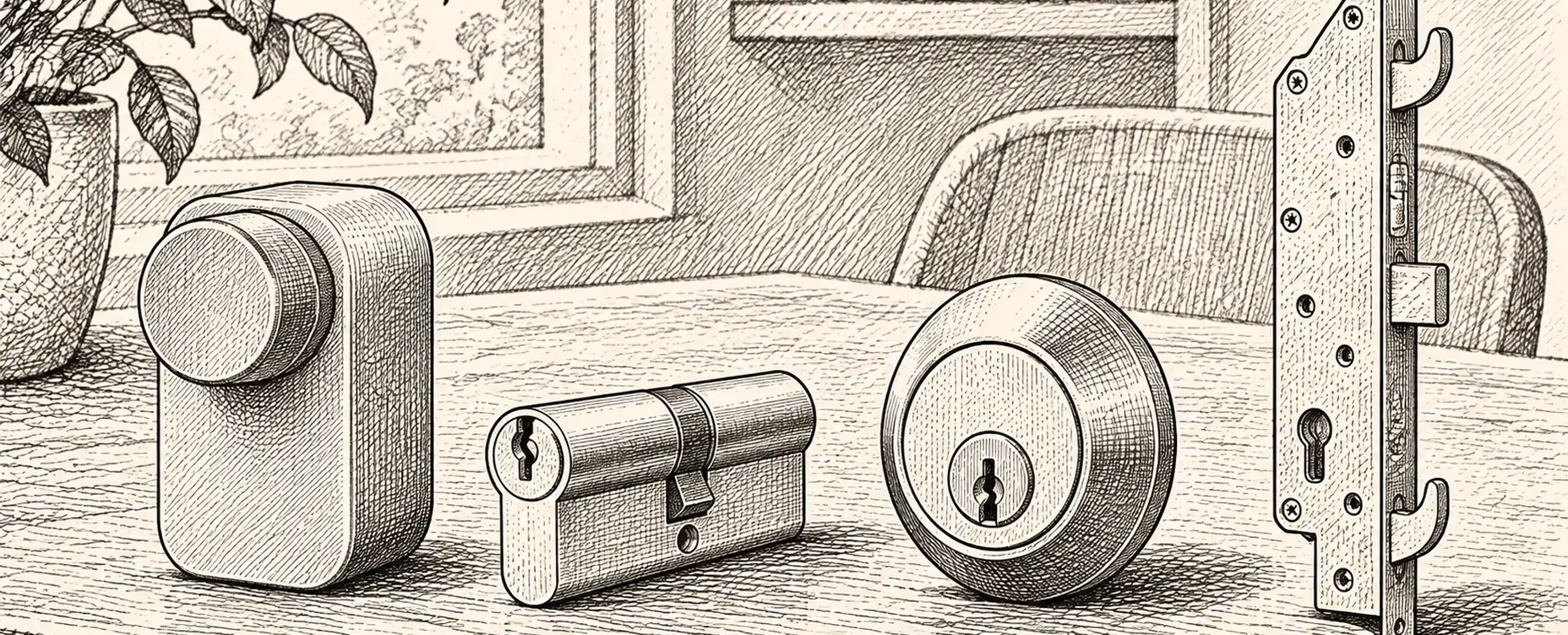
Retrofit thumbturn motors fit over the inside of an existing euro cylinder or deadbolt and physically turn it. The external appearance and the key are unchanged, installation takes minutes, and it is reversible — which makes it the obvious choice for a rented property. The mechanism is only as secure as the existing cylinder, and it is bulky on the inside.
Replacement cylinders swap the euro cylinder itself for one with electronics inside, keeping the existing handle and multipoint mechanism. Tidy, and available with proper anti-snap security ratings. Common in continental Europe where euro profile cylinders are the norm.
Replacement deadbolts substitute the entire lock body, common in North America where a separate deadbolt above the handle is standard. Straightforward, and not applicable to most European multipoint doors.
Motorised multipoint locks replace the whole locking mechanism in a uPVC or composite door, engaging all the hooks and bolts electrically. The most secure and capable, the most expensive, and it requires a locksmith.
Measure and identify your door before browsing. A great many disappointing purchases are simply the wrong type for the door.
Physical security first
A lock's electronics are irrelevant if the cylinder can be snapped in ten seconds, and cylinder snapping is a fast, quiet technique requiring no skill that accounts for a meaningful share of forced entries.
What to look for: a cylinder tested to a recognised anti-snap standard for your market — in the UK that is a three-star kitemarked cylinder or a Sold Secure Diamond rating, in Europe look for the relevant DIN or SKG classification. Also worth having: anti-drill, anti-pick and anti-bump protection, and a reinforced strike plate with long screws into the frame rather than just the architrave.
Two important cautions. Some smart locks are not certified at all, because certification costs money and the marketing does not need it. And on several retrofit designs, the security is entirely determined by the cylinder you already have — so upgrading the cylinder first is often the better first purchase.
Also check your insurance conditions. Some policies specify a lock standard for external doors, and fitting something non-compliant can matter at claim time.
The question that matters most: how do you get in when it fails?
Batteries die, electronics fail, hubs go offline, phones break, and internet connections drop. Every one of those will happen eventually.
So before anything else: what are the ways into this house that do not depend on electricity or a network?
Acceptable answers include a physical key that still works, a keypad code validated on the lock itself, or a local credential such as a fob or card read by the lock without needing the internet.
Unacceptable answers: only a phone app; only a cloud-verified code; only Bluetooth from one specific device. Those are single points of failure standing between you and your own house on a cold night.
Related details worth checking. Low battery warning that gives you weeks of notice, not hours. An emergency power option — some locks accept a battery pack pressed against external contacts. And a battery type you can buy locally at 9pm.
Keypad, phone, fob or face
Keypads are the most practical for households. No phone needed, codes can be given and revoked, and children and visitors manage fine. Two considerations: wear patterns on the buttons reveal which digits are used, so scrambling keypads or an occasional code change matters; and overlooking from the street.
Phone Bluetooth is convenient and depends on your phone having charge and working reliably. Auto-unlock on approach is pleasant and prone to false triggers when you walk past the house.
Fobs and cards are excellent for children, older relatives and anyone who does not want an app. They can be revoked if lost, unlike a key.
Fingerprint readers work well indoors and are less reliable outside in cold, wet or dirty conditions, where wet or cold fingers frequently fail to read. Useful as one option among several, poor as the only one.
Face recognition is appearing on doorbells and locks. Consider carefully what happens to that data and whether it is processed locally, and note that biometric data attracts specific legal protection in many countries.
The sensible arrangement is two or three methods: a keypad for everyday use, a physical key as backup, and phone or fob for convenience.
Where the intelligence lives
The same local-versus-cloud question as everything else, with higher stakes.
Locks that verify credentials locally work during an outage. Codes are stored on the device, checked on the device, and the lock opens.
Locks that verify in the cloud cannot open when the connection is down, which is a design we would avoid for a front door.
Protocol matters for longevity. A lock speaking Z-Wave, Zigbee, Thread or Matter can be adopted by a different controller later. A lock speaking only to one manufacturer's app is tied to that company's continued existence — and there is a real history of smart lock services being withdrawn.
Ask the question we suggest for everything: if this company disappeared tomorrow, would this still lock and unlock my door? For a good lock the answer is yes.
The practical details people discover afterwards
Auto-lock timing. Locking after a set period is the feature that actually improves security, because unlocked doors are a real cause of burglary. Set it long enough that you are not locked out while carrying shopping in, and consider requiring the door to be closed first — a lock that throws a bolt into an open frame damages the door.
Door position sensing. A lock that knows whether the door is actually closed, not just locked, is considerably more useful. Where the lock cannot tell, add a separate contact sensor.
Handle and multipoint interaction. On European doors the handle usually must be lifted to engage the hooks before the cylinder turns. Motorised cylinders cannot lift a handle, so they secure the latch only unless the mechanism is designed for it.
Noise. Some motors are loud. In a flat with a bedroom beside the door, this matters.
Weather. Check the rating if the lock is exposed, and note that cold reduces battery life significantly.
Fire safety. An external door must be openable from inside without a key in an emergency. Do not create an arrangement where escape depends on finding something.
Automations that are worth it, and one to avoid
Lock at night, checking the door is closed first and notifying if not. The single most valuable rule.
Lock when everyone leaves, with the same closed-door check.
Notify on unlock, ideally naming which code was used, so you know the cleaner arrived.
Lights and heating on arrival, triggered by a specific person's code.
Unlock on a confirmed smoke alarm, so escape and access are not impeded — worth thinking about carefully, and on balance a good idea in most households.
Alert if unlocked for an unusually long time, which catches a door left ajar.
The one to avoid: automatic unlocking on approach without confirmation. Geofencing is imprecise, phones misreport, and a door that unlocks because you walked past on the pavement is a security hole. Require an explicit action.
A checklist before buying
- Identify your door type and what will physically fit.
- Check the cylinder security rating, and upgrade the cylinder first if it is weak.
- Confirm at least two non-electronic ways in.
- Confirm credentials are verified locally.
- Check the protocol so another hub could adopt it later.
- Check battery type, life and warning period.
- Check your insurance for lock standard requirements.
- Plan auto-lock with a closed-door condition before you fit it.
Item three is the one we would insist on. Convenience is why people buy smart locks; being able to get in regardless is why they keep them.