The kitchen: air, fire and water before anything with a screen
The room with the most energy use, the most moisture, the most particulates and the most fire risk — and the one where projects add gadgets instead.
The room with the most energy use, the most moisture, the most particulates and the most fire risk — and the one where projects add gadgets instead.
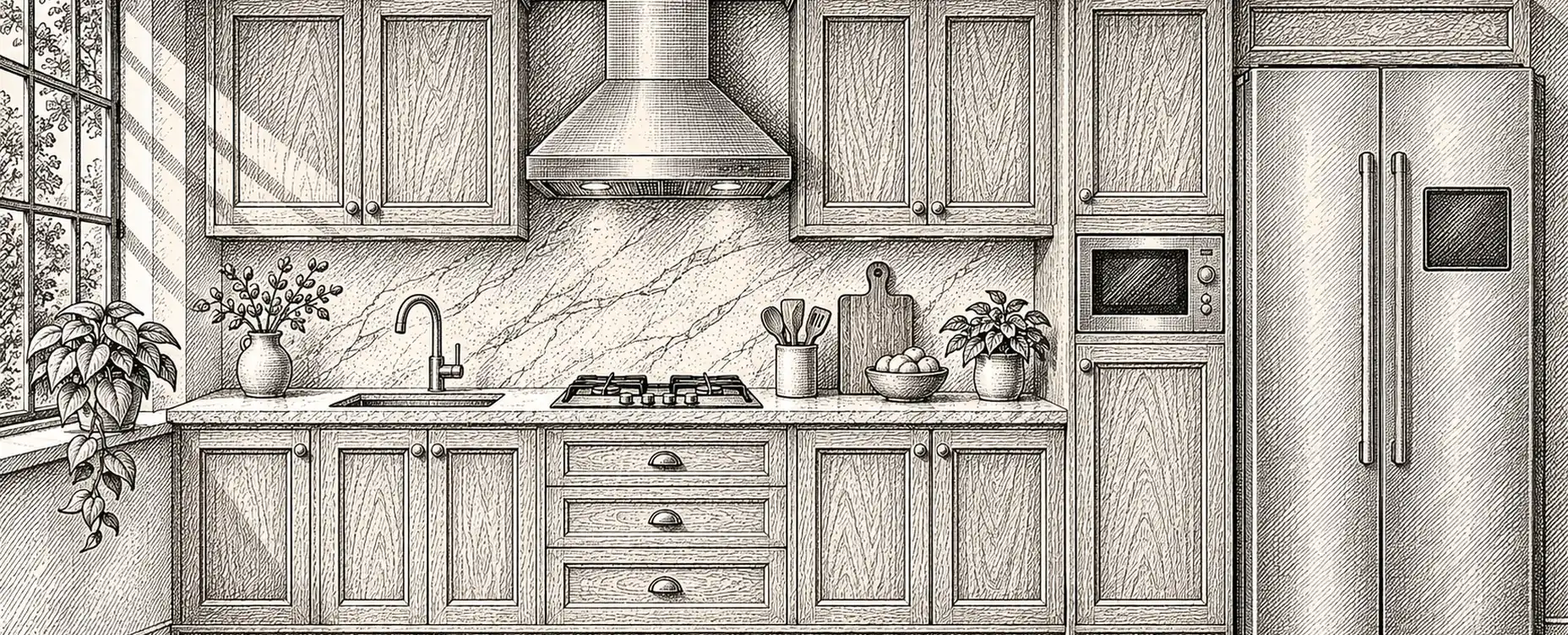
The kitchen is where a household spends the most energy, produces the most moisture and particulates, and creates the most fire risk. It is also the room where smart home projects most often add gadgets rather than address any of that.
Here is what we would actually do in a kitchen, in order of how much difference it makes.
Cooking is the dominant source of fine particulates in most homes, and frying, grilling and anything involving hot oil produces spikes that dwarf typical outdoor pollution. It is also a major source of moisture.
Three things determine whether your extraction works:
Does it vent outside? A recirculating hood passes air through a grease filter and a charcoal filter and returns it to the room. It removes some odour and grease and does very little for fine particles or moisture. A ducted hood venting outside removes both. If you are refitting a kitchen, this is the decision to get right, and it is very difficult to change afterwards.
Is it running early enough? Most people switch the hood on when the room is already full of smoke. Starting it before you begin cooking, and leaving it running for ten or fifteen minutes afterwards, changes the outcome substantially.
Is the duct any good? A long run of crushed flexible ducting with several tight bends destroys the airflow the hood was rated for. Short, rigid, smooth and as straight as possible.
Automating it is straightforward and genuinely useful: trigger the hood on hob power using an in-line meter or a temperature rise, and keep it running until particulates return to baseline rather than for a fixed time. That single automation does more for indoor air quality than any purifier.
Kitchen fires are the most common domestic fires, and cooking left unattended is the leading cause.
Use a heat alarm in the kitchen, not a smoke alarm. Smoke alarms in kitchens nuisance-trigger on toast and steam, and nuisance alarms get disabled — which is how a house ends up unprotected. A heat alarm responds to temperature rise and ignores cooking fumes.
Put an optical smoke alarm in the adjacent hallway, interlinked with the rest of the house.
Keep a fire blanket within reach, and know that a pan fire is smothered, never doused — water on hot oil is violent.
Never use a smart plug for anything with a heating element you would not leave unattended. Remote switching means switching something you cannot see.
Where automation helps: a heat alarm triggering the extraction to stop rather than start, so smoke is not drawn through the house; every light coming on at full brightness; a notification if you are out; and, if you have a gas hob with an appropriate valve, a shut-off.
Where automation does not help: nothing replaces being in the room. The most useful kitchen safety automation we know is unglamorous — a reminder that the hob has been drawing power for an unusually long time, which catches the pan someone forgot.
Kitchen energy use is less obvious than people assume, and measuring beats guessing.
The fridge and freezer are usually the largest kitchen consumers, because they run continuously. An old, poorly sealed or badly placed fridge can use several times what a modern one does. Check the door seal with a piece of paper — if it pulls out easily the seal has failed — and make sure there is clearance behind for the condenser to shed heat. A fridge squeezed into a cabinet beside an oven works considerably harder.
Cooking is intermittent but intense. Induction is markedly more efficient than gas or radiant electric, a microwave far more efficient than an oven for small quantities, and an air fryer or a small combination oven more efficient than heating a large cavity for two portions.
Kettles are efficient in principle and wasteful in practice, because most people boil far more water than they use. Boiling only what you need is a small, real saving repeated several times a day.
Dishwashers use considerably less water and energy than washing the same load by hand under a running tap, and the eco cycle uses less of both by running longer at lower temperature.
Standby loads from a coffee machine, a microwave clock, a wine cooler and an assortment of chargers add up quietly.
Measure with a plug for a week before changing anything. The results reliably surprise people, and they redirect spending.
Cooking releases a lot of water into the air, and in a well-sealed house it has nowhere to go.
Lids on pans reduce both moisture and cooking time.
Extraction while boiling, not just while frying.
A humidity sensor in the kitchen, with the extractor running until it returns to the household baseline — a relative comparison, which works in summer and winter alike where a fixed threshold does not.
Do not dry laundry in the kitchen if you can avoid it, since it is the largest avoidable moisture source in most homes.
The kitchen contains more water connections than any other room: a sink, a dishwasher, often a washing machine, sometimes a plumbed fridge, and occasionally a boiling water tap.
What we would fit, and it is cheap: a leak sensor under the sink, one behind the dishwasher and washing machine, and one behind a plumbed fridge, which is a surprisingly frequent culprit because the small supply line is easy to damage when the appliance is pushed back.
Then isolation valves on each appliance supply, so they can be turned off individually without hunting for the stopcock, and replace old flexible hoses, which are consumables that perish and then fail at full mains pressure.
Extraction on hob power, running until air quality returns to baseline.
Under-cupboard task lighting on occupancy, which is the single most appreciated kitchen automation and also fixes the shadow problem created by ceiling downlights.
Dishwasher and washing machine cycle-complete notifications from metering plugs.
Freezer and fridge temperature alerts, plus a door-ajar warning after two minutes.
Leak sensors wired to an automatic shut-off valve, if you have one.
Hob-left-on reminder based on unusual duration.
Kettle and coffee machine off standby overnight.
Appliances scheduled into cheap hours, with a courtesy limit if you share walls with neighbours.
Bin day reminder, which is trivial and one of the most-used automations in any household we have built for.
Fridge cameras and door screens, which are consistently unused.
Recipe integration with appliances.
Voice assistants built into appliances rather than a separate speaker you can replace.
Anything that removes a physical control from a cooking appliance, because you will want it with wet or floury hands.
Air purifiers as a substitute for extraction. A purifier filters the particles after they have spread through the room; a hood removes them at the source. Extraction first, always.
Items one to three are about air, fire and water — the three things a kitchen can genuinely do to a house — and together they cost less than a mid-range connected oven.