Medication reminders that people actually follow
Forgetting, uncertainty, complexity and reluctance are four different problems. Buying a reminder for the wrong one is the most common mistake.
Forgetting, uncertainty, complexity and reluctance are four different problems. Buying a reminder for the wrong one is the most common mistake.
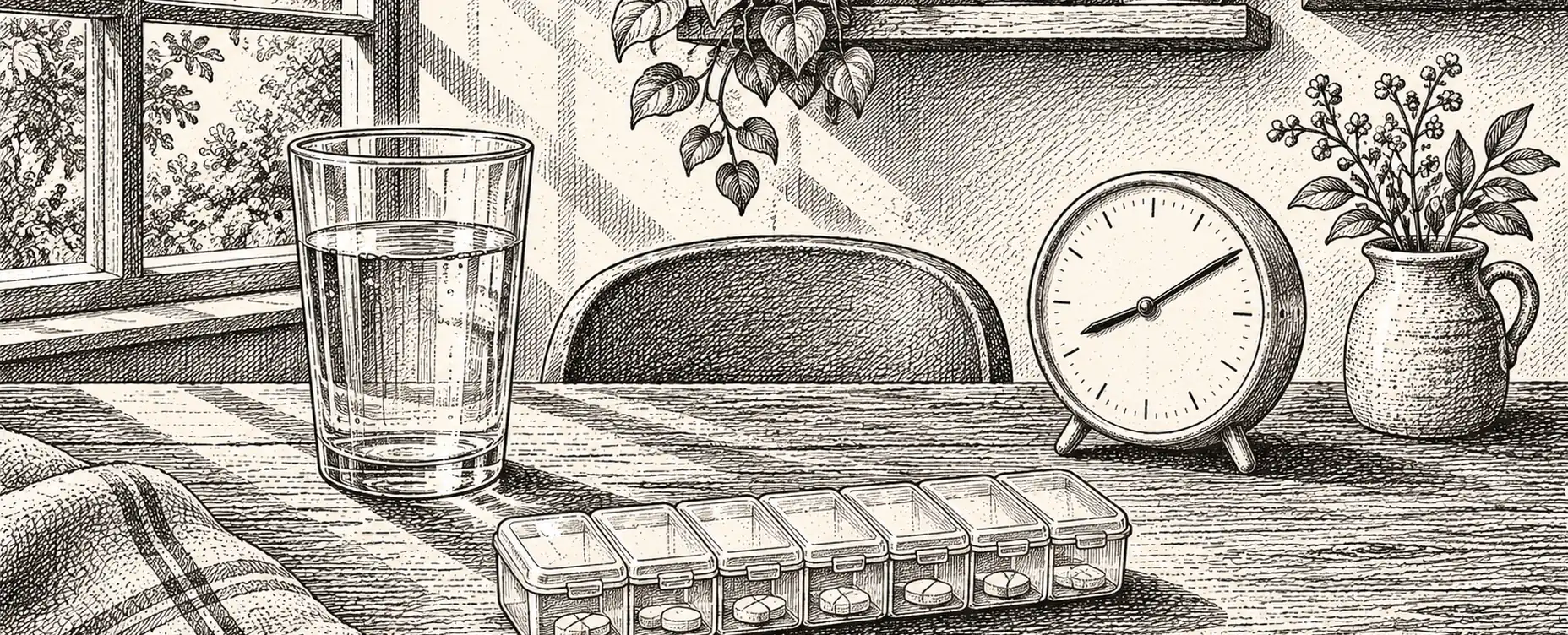
Medication non-adherence is one of the least glamorous and most consequential problems in home care. People miss doses, double up because they cannot remember whether they took one, or stop a course early because they feel better. The consequences range from a treatment quietly not working to a hospital admission.
It is also a problem that technology addresses unusually well, provided the technology is chosen to fit the actual failure. That is the part people get wrong: they buy a reminder when the problem was never remembering.
“Not taking medication properly” hides at least four distinct failures, and each needs something different.
Forgetting. The person intends to take it and the moment passes. A reminder genuinely helps.
Uncertainty. They cannot recall whether they already took today's dose, so they either skip it or take a second. A reminder does nothing; what helps is a visible record of whether the dose was taken.
Complexity. Eight medicines at four different times, some with food, some without. The problem is the schedule, and the answer is usually a pharmacy-prepared blister pack rather than any device.
Reluctance. Side effects, disbelief that the medicine is needed, or difficulty swallowing. No amount of technology addresses this, and a reminder system will simply record the refusal. This one needs a conversation with a prescriber.
Diagnosing which of these applies takes one honest conversation and saves buying the wrong thing.
A weekly organiser with compartments, plus an audible reminder from a smart speaker or a simple alarm. Costs almost nothing and solves both forgetting and uncertainty, because the empty compartment is the record. For a great many people this is genuinely the right answer, and it is worth trying before anything more complex.
The improvement automation adds is escalation: if a spoken reminder at nine is not followed by any kitchen activity by half past, a message goes to a family member. That turns a prompt into a safety net without adding hardware.
Many pharmacies will dispense medication into sealed, dated blister packs organised by day and time. This addresses complexity better than any consumer device, is prepared by a professional, and removes the risk of a well-meaning relative sorting tablets incorrectly. If the difficulty is a complicated regime, start here rather than with technology.
Boxes and bottle caps that detect being opened and report it. They confirm that a compartment was opened, which is a decent proxy for a dose taken and is not the same thing. Cheap, unobtrusive, and they work with existing packaging.
Lockable devices holding weeks of medication, dispensing only the correct dose at the correct time, alarming if it is not collected and notifying a carer. These are the right tool when unlocked access to medication is itself a risk — where someone might take a second dose having forgotten the first — because they physically prevent it rather than reminding against it.
They are more expensive, need refilling by someone reliable, and require power. Check what happens in a power cut: a good unit continues on battery and does not lose its schedule.
A phone notification is the weakest option, because the phone may be in another room and notifications are easy to dismiss reflexively. A spoken announcement on a speaker in the room where the person actually is at that time of day is far more effective. If mornings happen in the kitchen, the kitchen is where the reminder belongs.
Attaching medication to something that already happens reliably works better than an arbitrary time. Trigger the reminder when the kettle is used in the morning rather than at 08:00 exactly, and it arrives at a moment the person is already in the right place and already standing up.
A sensible ladder: a spoken reminder; a repeat fifteen minutes later; a gentle visual cue such as a lamp changing colour; and if the dose is still not registered after an hour, a message to a family member. What you must avoid is a system that nags indefinitely. Repeated alarms get switched off, and a switched-off system protects nobody.
The best confirmation is passive: the compartment opened, the dispenser released, the box lid lifted. Asking somebody to confirm in an app that they took their tablets is both easily gamed and quietly infantilising.
A surprising share of missed doses are not missed at all — the medication simply was not there. Repeat prescriptions lapse, a pharmacy order is not collected, or a dispenser is refilled a day late. No reminder helps with an empty box.
Two cheap safeguards. Count down: if you know a pack holds twenty-eight days, set a reminder at day twenty-one to order the repeat, so there is a week of slack. And make refilling a named person’s task with a recurring prompt, rather than something everyone assumes someone else did. Where a dispenser is in use, its own low-supply warning should go to whoever refills it and to one other person, because the whole system depends on that one task happening on time.
A shared record of doses taken is reassuring, and it can also become a source of friction if it turns into a daily audit. Two principles keep it healthy.
Send summaries rather than every event. A weekly overview is useful. A notification for every dose creates an expectation of surveillance and, worse, means the genuinely important alert arrives in a stream of unimportant ones.
Alert on missed doses only, and agree in advance what happens then. If the answer is “phone and ask”, say so, so the call is expected rather than intrusive.
A medication system that fails silently is worse than none, because everybody assumes it is working. The safeguards are the same as elsewhere in this category and more important here: local processing so an internet fault does not stop reminders, the hub on a small uninterruptible supply, and an alert if the dispenser or sensor stops reporting for twenty-four hours.
Test the escalation path deliberately every few months by ignoring a dose on purpose. It is the only way to discover that the notification has been going to a phone number that changed last year.
Almost everything in that list is cheap or free, and the expensive option is last for a reason. The measure of success is not how much the system reports — it is how rarely anybody needs to think about it.