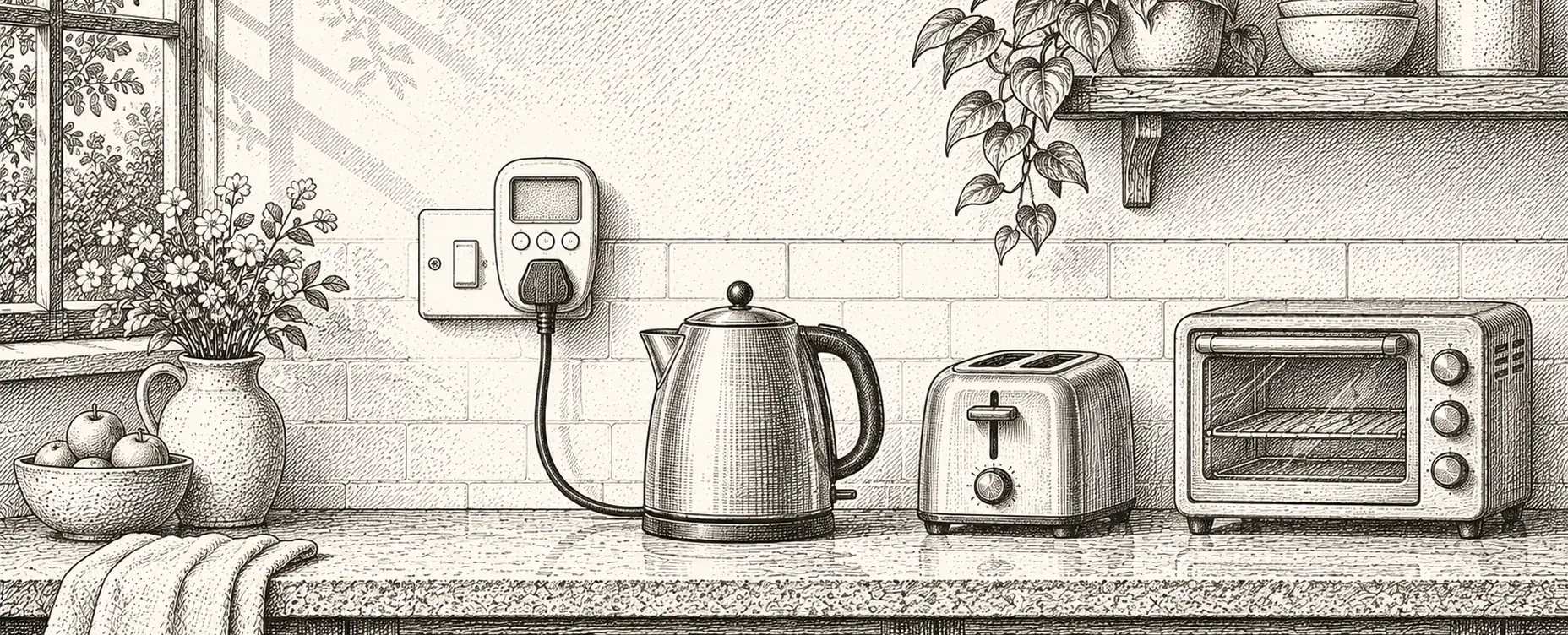
Most people have a mental ranking of what costs money at home, and it is usually wrong. The lights get blamed, the tumble dryer gets defended, and the actual biggest consumer sits quietly in a cupboard doing something nobody thinks about.
Per-appliance measurement fixes this, and it is one of the few pieces of home technology that reliably changes behaviour — because a number attached to a specific machine is far more persuasive than a general instruction to use less.
The arithmetic you need, and it is simple
Two units, and confusing them is the source of most misunderstanding.
A watt (W) or kilowatt (kW) is a rate — how fast electricity is being used right now, like the speed on a speedometer. A kilowatt-hour (kWh) is a quantity — how much was used over time, like distance travelled. Your bill is in kilowatt-hours.
The conversion is: power in kilowatts, multiplied by hours of use, gives kilowatt-hours. A 2 kW heater for three hours is 6 kWh. Multiply by your unit rate to get cost.
This is why a high-power appliance used briefly can cost less than a low-power appliance left on. The kettle at 3 kW for two minutes is 0.1 kWh. A 100 W device left on all day is 2.4 kWh — twenty-four times as much.
Where the money usually is
Rough rankings for a typical home, though yours will differ and that is precisely why you should measure.
Nearly always the top of the list
Heating, by a wide margin in cooler climates. Whether it appears on your electricity bill depends on whether it is gas, oil or electric — and with a heat pump it moves onto the electricity bill entirely.
Hot water. Substantial, and often invisible because it is bundled with heating.
Frequently underestimated
Tumble dryers. Genuinely expensive per cycle. Heat-pump dryers use markedly less than vented or condenser models, which is one of the few appliance upgrades with a clear energy case.
Electric showers, which draw enormous power — frequently 8–10 kW — for short periods.
Old fridges and freezers, because they run continuously.
Electric heating of any kind, including towel rails, panel heaters and underfloor loops that somebody enabled years ago.
Frequently overestimated
LED lighting. Once a house is on LEDs, lighting is usually a small fraction of the bill. Turning off lights is good practice and it is not where the savings are.
Phone and laptop charging. Trivial.
Televisions in use. Modern sets are efficient; it is the standby and the surrounding equipment that add up.
The wild card
Electric vehicle charging, which for many households becomes the single largest electrical load, exceeding everything else combined.
Measuring it properly
The rotating plug method
One metering smart plug, moved around the house, measuring one appliance for a full cycle or a full day. Cheap, thorough, and it gives you your own numbers rather than a generic table.
Two practical points. Measure a complete cycle for anything that cycles — a washing machine, a fridge, a dishwasher — because the average over a full cycle is the useful figure and the instantaneous reading is not. And check the plug's rating: 10 A plugs handle about 2,300 W and are fine for lamps and electronics, while anything that heats or has a motor needs a 16 A plug.
Circuit-level measurement
For anything hard-wired — the shower, the oven, the immersion heater, the heat pump — a plug is no use. Clamp-on circuit monitoring in the consumer unit is the answer, and it is an electrician's job.
Whole-house plus subtraction
A useful trick with only a whole-house meter: watch the total, switch one thing on, note the step change. Crude, immediate, and it works for anything with a distinct signature.
Turning numbers into decisions
Measurement without a decision is trivia. Three decisions it genuinely informs:
What to replace. An old cold appliance running continuously, or a vented tumble dryer used several times a week, are the two replacements with the clearest arithmetic. Work out the annual cost difference and compare it with the purchase price.
What to shift. If you are on a time-varying tariff, knowing which loads are large and flexible tells you what to move. Dishwasher, washing machine, dryer, hot water and car charging are the shiftable ones; cooking and showering are not.
What to stop worrying about. Genuinely valuable. Households that discover lighting is two per cent of their bill stop having arguments about light switches and put the effort where it matters.
The cost per use, which is the number that lands
Annual figures are useful for deciding what to replace. Cost per use is what changes day-to-day behaviour, because it maps onto a decision somebody is actually making.
Work it out for the handful of things you use discretionarily: a tumble dryer load, a dishwasher cycle at each of the programmes you use, an hour of the electric heater in the spare room, a bath’s worth of hot water. Write the figures on a piece of paper and put it somewhere relevant.
Two things tend to emerge. The gap between an eco programme and a normal one on a dishwasher or washing machine is frequently larger than people expect, which makes the slower cycle an easy habit to adopt. And the electric heater in one room, used casually, often costs several times what people assume — which is usually the single most actionable finding of the whole exercise.
The behavioural effect, which is real
There is reasonably consistent evidence that giving households visible, timely feedback on consumption reduces it, though the size of the effect varies between studies and tends to fade unless the feedback stays visible. We would not promise a percentage.
What we would say from experience is that specific feedback works better than general. “The tumble dryer costs this much per load” changes behaviour in a way that a monthly total never does, because it attaches a number to a decision somebody is about to make.
A fortnight of measuring
- Days 1–3: the cold appliances. Full 24-hour cycles, since they run continuously.
- Days 4–7: the wet appliances — washing machine, dishwasher, dryer — measuring complete cycles on the programmes you actually use.
- Days 8–10: the media stack and any desk setup, both in use and idle.
- Days 11–14: anything that heats. Towel rails, panel heaters, kettle, oven if it is on a socket.
- Then: write down annual costs for each, ranked, and act on the top three.
Two weeks, one plug, and a list that is specific to your house rather than to an average one. That list is worth more than any general advice about energy saving, including this article.