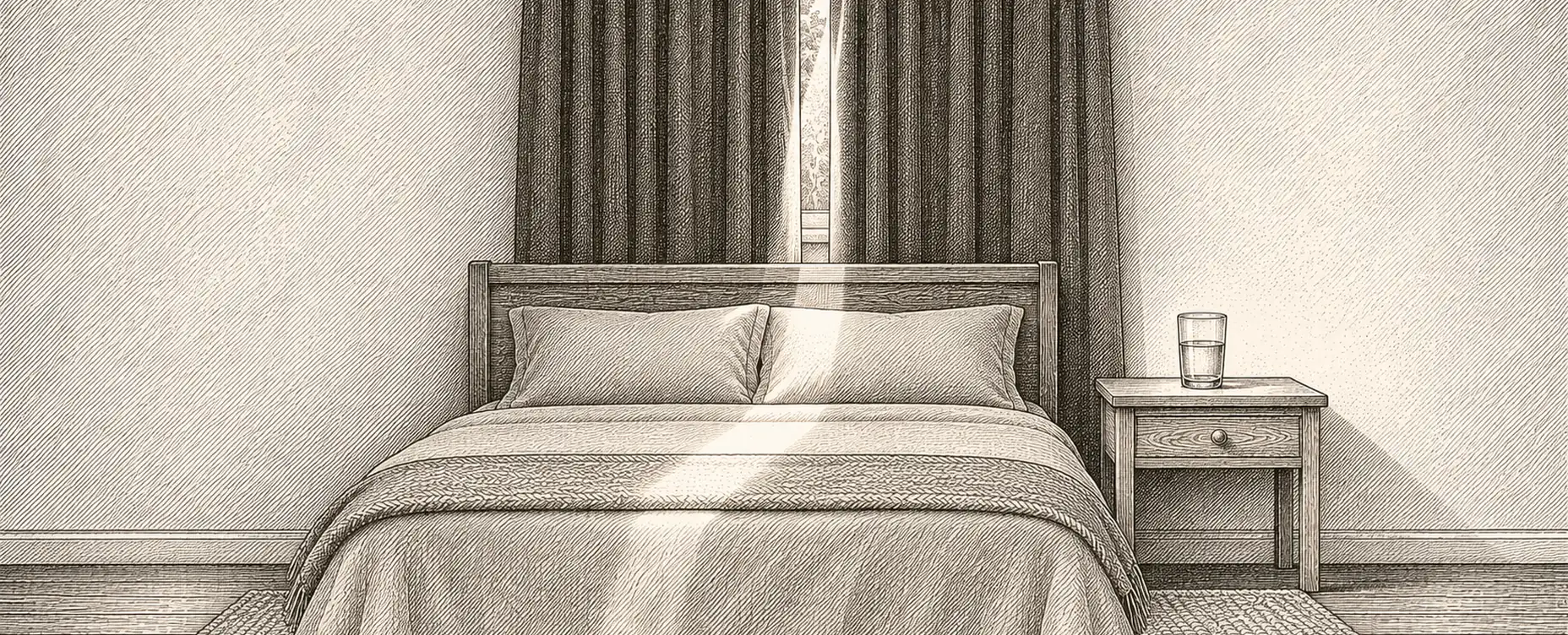
Sleep is the area where smart home technology is both most oversold and genuinely capable of helping. It cannot fix insomnia, and no device replaces the behavioural approaches that clinical evidence supports. What it can do is remove the environmental obstacles — light, temperature, noise and an inconsistent routine — that make good sleep harder than it needs to be.
That is a narrower claim than the marketing makes, and it is worth doing well, because the environmental factors are the ones you can change without effort once they are set up.
Temperature: the most underrated factor
Core body temperature falls as you fall asleep, and that fall is part of the mechanism rather than a side effect. A bedroom that is too warm interferes with it, which is why heat makes sleep restless in a way most people recognise but few connect to the thermostat.
Sleep researchers generally point to a bedroom somewhere around 16 to 19 °C, cooler than most people keep their living space. Individual preference varies, and the useful move is not to adopt a number but to measure your own bedroom and experiment across a range.
Three practical automations follow. Drop the bedroom setpoint an hour before bed rather than at bedtime, since a room takes time to respond. Let it run cooler overnight and rise shortly before you wake, because a cold room makes getting up harder. And in summer, pre-cool in the evening or ventilate when the outdoor temperature drops below the indoor temperature — a comparison a sensor can make and you cannot.
Light: timing matters more than brightness
Light is the dominant signal for your circadian rhythm, and the relevant variable is when you get it, not just how much.
Bright light in the morning, ideally within an hour of waking and ideally daylight, is the strongest and best-evidenced intervention for a stable sleep pattern. Where daylight is not available — a northern winter, a shift pattern — bright artificial light helps.
Dim, warm light in the evening. The specific claims about blue light are frequently overstated in consumer marketing; the effect exists but overall intensity matters at least as much as colour. Practically, dimming everything in the last hour or two is more effective than filtering blue while keeping the room bright.
Darkness at night. Genuinely dark, which most bedrooms are not: standby LEDs, a router, street lighting through thin curtains. Blackout blinds or curtains and a strip of tape over indicator lights are cheap and effective.
Light on waking, gradually. Simulated dawn — a light ramping up over twenty to thirty minutes before your alarm — has reasonable supporting evidence for making waking feel less abrupt, particularly in winter when you would otherwise wake in darkness.
All four are straightforward to automate, and the evening dimming is the one that most reliably changes how people feel.
Air: the reading that surprises people
A closed bedroom with the door shut and two adults breathing will typically climb well past 1,500 parts per million of carbon dioxide by morning, and often past 2,500. Studies looking at bedroom ventilation have found associations with sleep quality and next-day alertness, and the intervention is trivial.
Options, in order of how much most people will tolerate: leave the bedroom door ajar, which alone makes a large difference; leave a window on a vent setting; or use mechanical ventilation if you have it. Measure first, because if your CO₂ sits at 800 all night this is not your problem and you can stop thinking about it.
Noise: masking beats silence for most people
Sudden noises fragment sleep even when they do not fully wake you, and the fragmentation is what damages sleep quality.
Complete silence is rarely achievable and not necessarily ideal, because it makes any single noise more startling. Steady broadband sound — a fan, a white or pink noise source — reduces the contrast between background and interruption, and many people find it markedly effective.
Automating it is simple and worth doing at low volume, and there is one thing to avoid: a source that switches off abruptly at a set time. The transition itself can wake you. Fade it out over several minutes, or leave it running.
Routine: the boring part that does the most
The best-evidenced sleep interventions are behavioural, and consistency is the centre of them.
Automation helps here not by doing anything clever but by making a routine effortless and consistent. A single evening scene — lights dimming, blinds closing, temperature dropping, sound starting, screens on a reminder — happening at the same time every day is a repeated cue, and the fact that it happens without your involvement is precisely why it keeps happening.
Our observation from years of building these systems: the automation that helps most is the least technically interesting one, which is simply a consistent wind-down that runs whether or not you feel like starting it.
What we would be sceptical about
Sleep tracking as a goal in itself. Consumer trackers estimate sleep stages from movement and heart rate, and their stage-level accuracy against clinical polysomnography is limited. They are reasonable at total sleep duration and poor at the detail. Worse, some people develop anxiety about their sleep scores — which is counterproductive, since anxiety about sleep is one of the things that most reliably damages it. If a tracker is making you worry, that is a sound reason to stop using it.
Devices claiming to induce sleep through sounds, vibration or fields. Evidence is thin to absent.
Very expensive mattress technology, before you have addressed a bedroom that is 23 °C, lit by a streetlight, and at 2,400 ppm of CO₂.
Shared bedrooms and different preferences
Two people rarely want the same bedroom, and this is where a fair amount of domestic friction lives. A few things genuinely help.
Separate bedding beats arguing about the thermostat. Two single duvets of different weights on a double bed — common across much of northern Europe and puzzling to everyone else — solves the temperature disagreement at source, without either person compromising.
Different wake times need different light. A dawn ramp that wakes both people when only one needs to be up is a net loss. Use a bedside light on the relevant side rather than a ceiling light, or an alarm that is silent and tactile.
Masking sound helps the lighter sleeper, including against the other person’s movement, and is worth trying before separate rooms are discussed.
And on that last point: couples who sleep separately some or all of the time are not doing anything wrong, and sleep researchers are notably relaxed about it. Sleeping well matters more than sleeping in the same room.
What we would set up, in order
- Measure for a week: bedroom temperature, humidity and CO₂ overnight. Change nothing yet.
- Fix darkness — blackout, and tape over the indicator lights.
- Set the temperature schedule: down an hour before bed, cooler overnight, up before waking.
- Add ventilation if your CO₂ reading justifies it. Door ajar first.
- Build one evening scene at a fixed time, with lights dimming gradually rather than switching.
- Add a dawn ramp on the light before your alarm.
- Try masking sound at low volume, faded rather than switched.
Steps one and two cost almost nothing and account for a surprising share of the benefit. Everything after is refinement, and none of it requires a subscription.