In most buildings, choosing a sensor is a question of accuracy, protocol and price. In a hospital there is a prior question that overrides all three: can it be cleaned, and does it get in the way of cleaning something else?
Infection prevention and control has authority over what may be installed in and near clinical areas, and that authority is well founded. Understanding what they will object to, and why, saves a great deal of wasted specification.
Why this is not bureaucratic
Healthcare-associated infection is a serious, measured, actively managed risk. Environmental surfaces contribute to transmission, cleaning regimes are designed and audited to address that, and anything introduced into the environment either supports those regimes or interferes with them.
A device with a textured housing, an air gap behind it, a recessed button or a cable loop is a place that cannot be cleaned properly. Multiply that across a few hundred sensors and you have made the cleaning task materially harder for no clinical benefit. That is the objection, and it is reasonable.
What infection control will look for
Smooth, non-porous, sealed surfaces
Housings that can be wiped down without trapping soil. Smooth plastic or metal, no textured finishes, no fabric, no ventilation slots that collect dust in a patient area.
Chemical compatibility
Hospital cleaning uses disinfectants — chlorine-releasing agents, alcohol, hydrogen peroxide, quaternary ammonium compounds — at concentrations that degrade some plastics, craze others and destroy printed labels. Ask the manufacturer specifically which agents the housing tolerates, and be sceptical of a vague answer. A device that becomes brittle and cracks after a year of chlorine wipes has become a worse problem than it solved.
Flush mounting, minimal profile
Anything protruding collects dust and gets knocked. Flush or near-flush mounting with a sealed perimeter is preferred, and the seal matters as much as the fit — an unsealed edge is a gap.
No cable loops or trailing leads
Cables must be contained and cleanable. This is one of the strongest arguments for battery or fully concealed installation in clinical areas.
Cleanable in place
Devices that must be removed to be cleaned will not be cleaned. The whole assembly needs to tolerate wiping as installed.
No fabric, foam or open vents in patient areas
Rules out a surprising amount of consumer equipment, including many speakers and some air quality sensors with open sensing chambers.
What this rules in and out
Generally acceptable in clinical areas, subject to local approval: sealed environmental sensors with smooth housings, flush-mounted or wall-recessed; hard-wired devices with fully concealed cabling; equipment specified for healthcare use by the manufacturer.
Generally acceptable in non-clinical areas: ordinary commercial building sensors in offices, plant rooms, stores, admin blocks and back-of-house corridors. This is another reason the non-clinical estate is the sensible place to concentrate effort.
Generally not acceptable in clinical areas: consumer devices with textured or vented housings; anything with fabric or foam; devices requiring exposed cabling; equipment that cannot be wiped as installed; and anything with a manufacturer who cannot tell you what disinfectants it tolerates.
Touch-free is a real advantage, not a gimmick
Hand contact surfaces matter in a hospital, and this is one area where automation offers a genuine infection control benefit rather than merely convenience.
Automatic lighting removes a switch from the contact chain in corridors, stores and toilets.
Automatic doors, where appropriate, remove handles — though door automation in a healthcare setting interacts with fire strategy and must be designed accordingly, never retrofitted casually.
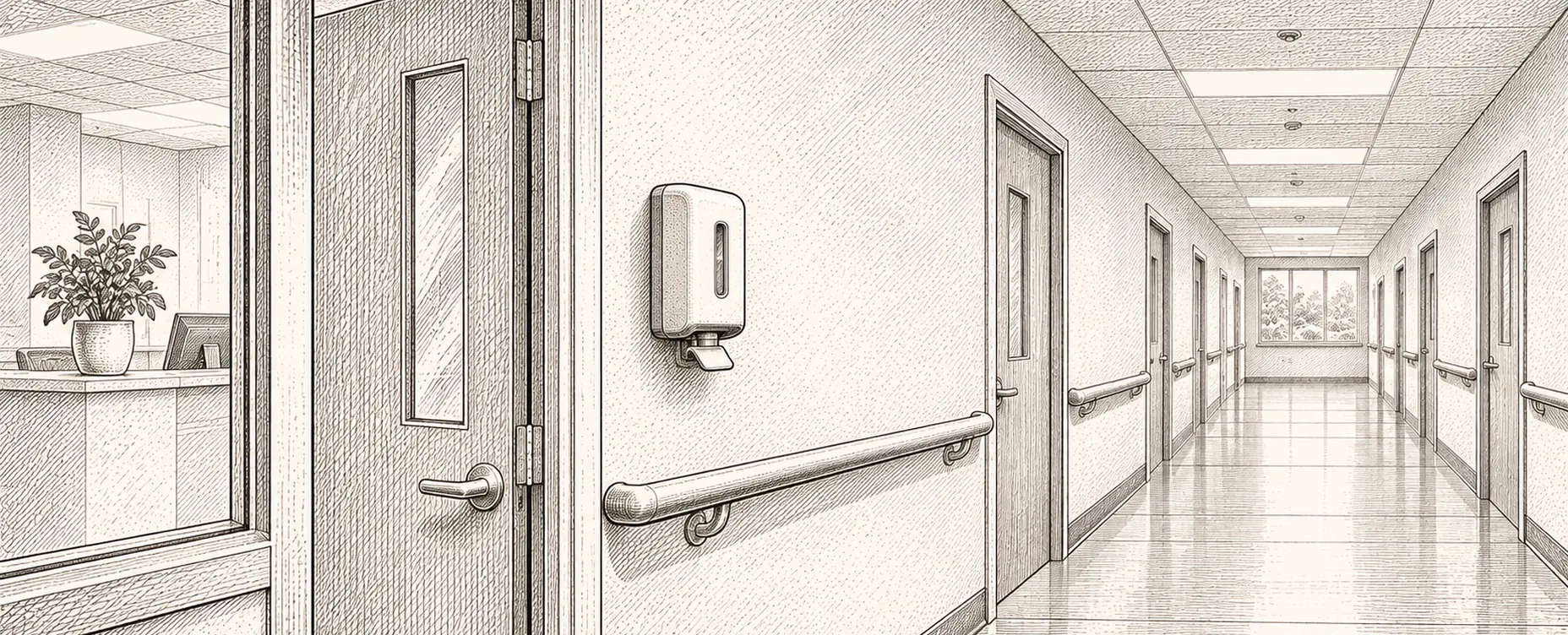
Sensor taps and dispensers are established practice for this reason, and their monitoring is genuinely useful: a soap or gel dispenser that reports when it is empty addresses a real and frequently observed problem, because an empty dispenser is a hand hygiene failure that nobody logged.
Voice control is occasionally proposed as touch-free. Be careful: microphones in clinical areas raise patient confidentiality concerns that usually outweigh the hygiene benefit, and we would not propose them near patient conversations.
Devices that support cleaning rather than getting in its way
A few applications are actively helpful to the infection control agenda, which makes them much easier to get approved.
Dispenser monitoring, as above. Arguably the single most useful sensing application in this space.
Room turnaround status. Occupancy sensing that shows whether a treatment room is vacant, and how long it has been vacant, supports cleaning scheduling — and does so without identifying anybody.
Humidity and temperature in clinical stores, where sterile packaging integrity depends on conditions being maintained.
Door contacts on isolation rooms, reporting whether a door has been left open. Handle with care and design with IPC, but the underlying information is clinically relevant.
Ventilation performance in areas with specified air change rates. This is regulated territory requiring specialist equipment and validation, but monitoring that a system is performing is squarely within the estates remit.
Where IPC and estates goals align
It is worth looking for the applications where both teams want the same thing, because those are the ones that get approved quickly and build the relationship for later.
Ventilation performance monitoring serves infection control and energy management simultaneously. IPC wants confidence that air change rates are being achieved; estates wants to know that fans are not running harder than necessary. The same data answers both.
Store room conditions protect sterile packaging integrity, which is an IPC concern, while also protecting stock value, which is an estates and procurement concern.
Water temperature logging is a patient safety control and an estates duty at once, as covered in the water safety article.
Leading with one of these rather than with a general monitoring proposal changes the framing entirely: you arrive as someone solving a problem IPC already has rather than as someone asking permission to install equipment.
Maintenance, which is also an IPC question
Changing a battery in a clinical area is not a casual task. It means entering a room, touching a device, and potentially working at height in a space where patients are present.
Three implications for specification. Choose long battery life and accept a higher unit cost for it — a five-year sensor is worth considerably more than a one-year sensor here. Prefer mains or Power over Ethernet in clinical areas where cabling is achievable, precisely to avoid the battery visits. And batch maintenance to planned work, so device servicing coincides with room turnaround or planned closures rather than generating individual interruptions.
A workable approach
- Concentrate on the non-clinical estate where ordinary equipment is acceptable and the constraints are commercial rather than clinical.
- For anything in or near clinical space, involve IPC at specification stage with the actual device and mounting proposal.
- Ask manufacturers for disinfectant compatibility in writing. Treat inability to answer as a disqualification.
- Prioritise long battery life or fixed power to minimise maintenance visits.
- Lead with the applications IPC actively wants — dispenser monitoring, store conditions, room status — because a first project that helps them makes every subsequent conversation easier.
- Document approvals as part of the project record.
The pattern here mirrors the rest of this category: work with the constraint rather than against it, start where you are unambiguously welcome, and let a useful result earn the next conversation.