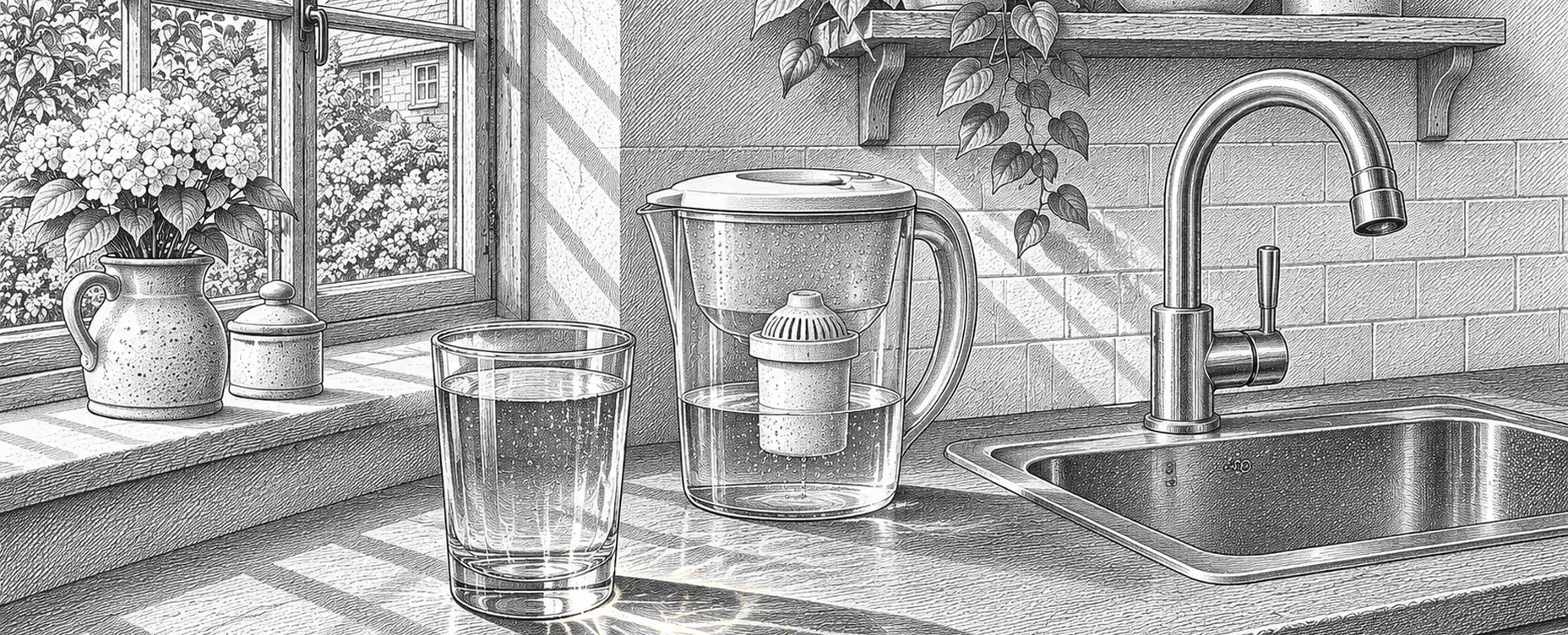
Water filters are sold on a vague promise of purity, and most households buying one have no idea what is in their water or whether anything needs removing. In much of Europe the honest answer is that the supply is closely regulated, tested frequently, and already very good.
That does not mean filtration is pointless. It means the useful question is narrower: what specifically do you want to change, and is there a cheaper way?
What is already regulated
Public water supplies in the EU and UK are governed by drinking water regulations setting limits on a long list of parameters — microbiological contamination, metals, nitrates, pesticides, disinfection by-products — with mandatory sampling and public reporting.
Two practical consequences. Your supplier publishes a water quality report for your postcode, usually online and free, and reading it takes five minutes and answers most questions people buy filters to answer. And the regulated point is the boundary of your property, so anything happening in your own pipework is your responsibility.
That last point is where the real domestic issues live.
The things worth actually caring about
Lead from your own plumbing. The one we would prioritise. Lead pipes and lead solder were used in older properties and remain in some supply pipes and internal plumbing. Lead is harmful with no safe level, and it is particularly concerning for infants and during pregnancy. Regulations have tightened limits progressively, and the source in a modern supply is almost always the building's own pipework rather than the mains.
How to check: look at the pipe where it enters your property. Lead is dull grey, soft enough to mark with a coin, has swollen joints, and gives a dull thud rather than a ring when tapped. If you suspect lead, many suppliers will test a sample free of charge — ask. Replacement is the answer; filtration is a stopgap.
Two interim measures: run the tap for a while before drinking if water has stood in pipes overnight, and never use hot water for drinking or cooking, which dissolves metals more readily and may have stood in a cylinder.
Chlorine taste and smell. Not harmful at supply concentrations and genuinely unpleasant to some people. The cheapest fix is free: a jug of water in the fridge for an hour lets chlorine dissipate.
Hardness and scale. A real nuisance and not a health issue, addressed by softening or scale inhibition rather than by drinking water filtration.
Private supplies. If your water comes from a well or a borehole rather than a public supply, everything above is reversed — you are responsible for quality, testing is your job, and regular microbiological and chemical testing is genuinely necessary. This is a different situation and worth taking seriously.
What each filter type does
Activated carbon — jug filters, tap-mounted units, under-sink cartridges. Good at chlorine, taste, odour and some organic compounds. Poor at dissolved minerals, nitrates and hardness. Cheap, effective for the most common complaint, which is taste.
Carbon block with a lead-reduction rating. A subset of the above, specifically certified for lead reduction. If lead is your concern and you cannot replace the pipe yet, this is the relevant product — and look for certification to a recognised standard rather than a marketing claim.
Ion exchange in jug filters reduces hardness slightly and is not a water softener.
Reverse osmosis forces water through a membrane, removing the great majority of dissolved substances. Genuinely thorough, and: it wastes water, typically several litres rejected per litre produced; it is slow and needs a storage tank; it removes beneficial minerals along with everything else, so many systems add a remineralising stage; and it is over-specified for a regulated European supply. It makes sense for a private supply with known problems, or where you have a specific contaminant to remove.
Ultraviolet treatment inactivates microorganisms. Appropriate for a private well; unnecessary on a chlorinated public supply.
“Alkaline”, “structured” and “hydrogen-rich” water devices. The health claims made for these are not supported by good evidence, and your stomach acid resets the pH of anything you drink within minutes. We would not spend money here.
The thing nobody mentions: filter maintenance
A neglected filter is worse than no filter, and this is the most common real-world problem.
Carbon media that is exhausted stops adsorbing and can host bacterial growth, particularly in a warm kitchen, and a jug filter left with standing water for days is a bacterial culture. Manufacturers specify replacement intervals for good reason and they are routinely ignored.
Practical rules: replace on schedule, not on taste, since taste improvement fails last; keep jug filters in the fridge; do not leave filtered water standing, because it has less residual disinfectant than tap water, which is precisely why it spoils faster; and flush a cartridge after any period of non-use, including after a holiday.
This is a good candidate for a reminder in your home system based on litres or on days, because it is exactly the kind of maintenance that quietly does not happen.
Boiling taps and chilled dispensers
Increasingly common, and worth a note.
Boiling water taps hold a small heated tank permanently, so they have a standing energy cost — modest with a well-insulated tank, and continuous. Against that, they avoid the very common waste of boiling a full kettle for one cup. Whether they save energy depends entirely on your kettle habits, and measuring your kettle for a week is the honest way to find out.
They also have real safety implications with young children, which is why the good ones require a deliberate two-action operation. And they need scale management in hard water areas, which is what the supplied filter is usually for — not purification.
Chilled and sparkling systems are a convenience purchase, which is fine. Their filters need the same discipline as any other.
Where monitoring helps
Not much, honestly, and a few things are worth doing.
Filter life reminders based on litres through a flow sensor, or on elapsed days.
Temperature alerts on stored water, since anything holding water in the 20 to 45 °C range needs thinking about for the same reasons as a hot water cylinder.
Leak sensors under any under-sink installation, which is a water connection in a cupboard nobody looks in — and reverse osmosis systems in particular have several joints and a drain connection.
Flow monitoring, which catches a system stuck in flush or reject mode wasting water continuously.
What is not available at domestic level: meaningful continuous measurement of contaminants. Consumer “water quality” meters generally measure total dissolved solids, which tells you about mineral content and nothing about whether the water is safe. A high reading in a hard water area is calcium, not contamination.
What we would do
- Read your supplier's water quality report for your postcode. Free, five minutes.
- Check your incoming pipe for lead, and ask your supplier for a test if unsure.
- Never drink or cook with hot tap water, and flush the tap after water has stood.
- If the complaint is taste, try a jug in the fridge before buying anything.
- Use a certified carbon block if lead reduction is genuinely needed, while arranging pipe replacement.
- Skip reverse osmosis on a regulated public supply unless you have a specific reason.
- Test properly and regularly if you are on a private well.
- Set a filter replacement reminder, and a leak sensor under the sink.
Steps one and two are the ones that matter. Almost everyone who does them discovers either that their water is fine and they wanted a jug in the fridge, or that they have a pipe worth replacing — and both of those are more useful than a filter bought on a hunch.