A burst pipe is the most expensive thing water does to a house. It happens in a few hours, usually while nobody is there, and it delivers water continuously into a structure until someone finds it.
It is also almost entirely preventable, and the prevention is mostly cheap. Here is the physics, then the practical measures in order of value.
Why pipes burst, which is not where you think
Water expands by roughly nine per cent when it freezes, and that expansion is what does the damage — but not usually at the ice itself.
What happens is that ice forms at the coldest point and grows into a plug. Continued freezing pushes water along the pipe, and if it cannot escape, pressure builds in the trapped section between the ice plug and a closed tap or valve. That pressure can be enormous, and the pipe fails at its weakest point — which is frequently some distance from the ice, at a joint or a fitting.
Two consequences follow. First, the failure often is not where the freezing was, which is why inspection after a freeze needs to cover the whole run. Second, leaving a tap slightly open on a vulnerable run relieves the pressure and is a genuinely effective emergency measure, because it gives the water somewhere to go.
And the damage typically appears on the thaw rather than during the freeze. A pipe splits while frozen and stays sealed by ice; the water arrives when it melts, often a day or two later. A house can look fine and flood on Tuesday.
Which pipes are at risk
Cold air, no heat input, and often no insulation. In order of how often they cause problems:
Loft pipework, especially above insulation, and in a well-insulated loft the space is colder than it used to be, which makes this worse rather than better after an insulation upgrade.
Garage and outbuilding runs, and anything in an unheated utility space.
External taps and their supply pipe, plus irrigation lines, which are the most commonly forgotten.
Pipes on external walls in unheated rooms, particularly in a cupboard where warm air cannot reach.
Under suspended floors with generous ventilation, which is a cold, windy space.
Condensate pipes from condensing boilers, which are a distinct and very common problem — they carry slow-moving acidic water, they are often plastic and run outside, and when they freeze the boiler shuts down. Cold house, cold water, and a call-out at the worst possible time.
Heating pipes in unheated spaces, which cannot rely on the heating running if the boiler has already stopped.
The measures, cheapest first
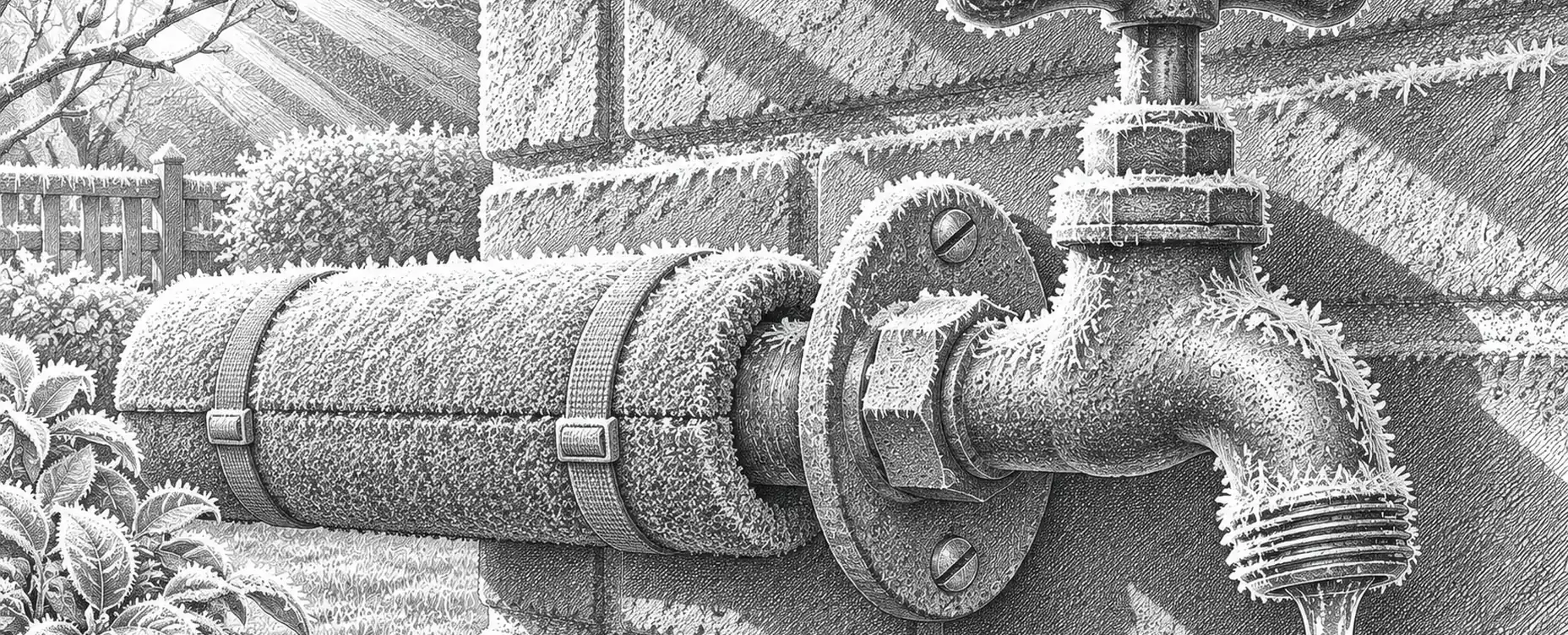
1. Insulate the pipes. Foam lagging costs very little and is the single most effective action. Two things people get wrong: gaps are what fail, so bends, valves and joints need covering rather than skipping, and lagging must be continuous. And in a loft, lag the pipes and do not insulate above them from the warm side — a pipe running above loft insulation is in cold air, so where possible pipes should sit below the insulation, or be lagged generously if they cannot.
2. Keep a background temperature. Never let a house go fully off in winter. A frost setpoint of 5 °C or so costs little and prevents everything in this article. Where a room contains vulnerable pipework, keep that room a little warmer and leave the cupboard door open so warm air reaches the pipes.
3. Drain what you can. External taps and irrigation should be isolated and drained before winter, which takes ten minutes and removes the risk entirely. Fit an isolation valve indoors if you do not have one.
4. Deal with the condensate pipe. Insulate it, and if it runs any distance outside, have it re-routed internally or upsized. This is the commonest winter boiler failure and it is a permanent fix rather than an annual worry.
5. Trace heating for genuinely vulnerable runs. A self-regulating heating cable wrapped along a pipe, thermostatically controlled, keeps it above freezing. Modest running cost, effective, and the sensible answer for a run you cannot insulate or relocate. Note it needs a properly installed supply, which is an electrician's job.
6. Seal draughts near pipework. Cold air blowing directly onto a pipe from an air brick or an unsealed penetration is often the actual cause. Blocking the draught — not the ventilation the building needs, just the direct blast — is free.
Monitoring, which buys you time
Insulation prevents; sensing tells you when prevention is not enough.
Temperature sensors wherever pipes run through cold space. Loft, garage, under-floor void, external cupboard. Cheap, and they turn an invisible risk into a number.
Alert at 4 °C, not at zero. You want warning before freezing, because after it there is nothing useful to do.
Alert on mains power loss, since a power cut ends your heating and your monitoring at once. This is the failure mode that turns a cold snap into a burst.
Alert on the heating not running when outdoor temperature is low. A boiler locked out on a frozen condensate pipe at 2am is exactly what you want to know about.
Automatic responses worth building: low loft temperature raises the heating setpoint a degree or two; low temperature plus an empty house closes the mains stopcock; and any leak sensor going wet closes it immediately.
Going away in winter
The highest-risk combination is a cold spell and an empty house, so this deserves its own routine.
Leave the heating on at a frost minimum. Not off. Many insurance policies require this, and some require the system drained for longer absences — worth reading the wording rather than assuming.
Turn the water off at the stopcock, which limits any burst to the water already in the pipes. This is the single most valuable action and it is free.
Open the loft hatch, so some warm air reaches the coldest pipework.
Leave internal doors and cupboard doors open so heat circulates.
Ask a neighbour to check, and give them a way in and the location of the stopcock.
Set your low-temperature and power-loss alerts and test that they reach your phone before you leave.
If a pipe does freeze
Practical, in order.
Turn the water off at the stopcock immediately, before thawing anything.
Open the nearest tap downstream to relieve pressure and give meltwater somewhere to go.
Thaw gently — warm towels, a hairdryer on low, a fan heater in the room. Never a blowtorch or any open flame, which can boil trapped water and burst the pipe violently, and is a fire risk in a loft.
Work from the tap end backwards toward the blockage, so meltwater can escape rather than being trapped.
Then inspect the whole run for splits before turning the water back on, and turn it on slowly while watching.
And if it has already burst: water off, electricity off in affected areas if water is anywhere near it, and photograph everything before you start clearing up.
An autumn checklist
- Lag every pipe in cold space, with no gaps at bends and valves.
- Insulate or re-route the boiler condensate pipe.
- Isolate and drain external taps and irrigation.
- Fit temperature sensors in loft, garage and any cold void, alerting at 4 °C.
- Add a mains power loss alert.
- Set a frost minimum everywhere and never turn heating fully off.
- Locate and free the stopcock, and make sure everyone knows where it is.
- Write the away-in-winter routine down so it happens every time.
Items one and three between them cost about the same as a takeaway and prevent the majority of burst pipes. Item seven costs nothing and matters most on the day it matters.