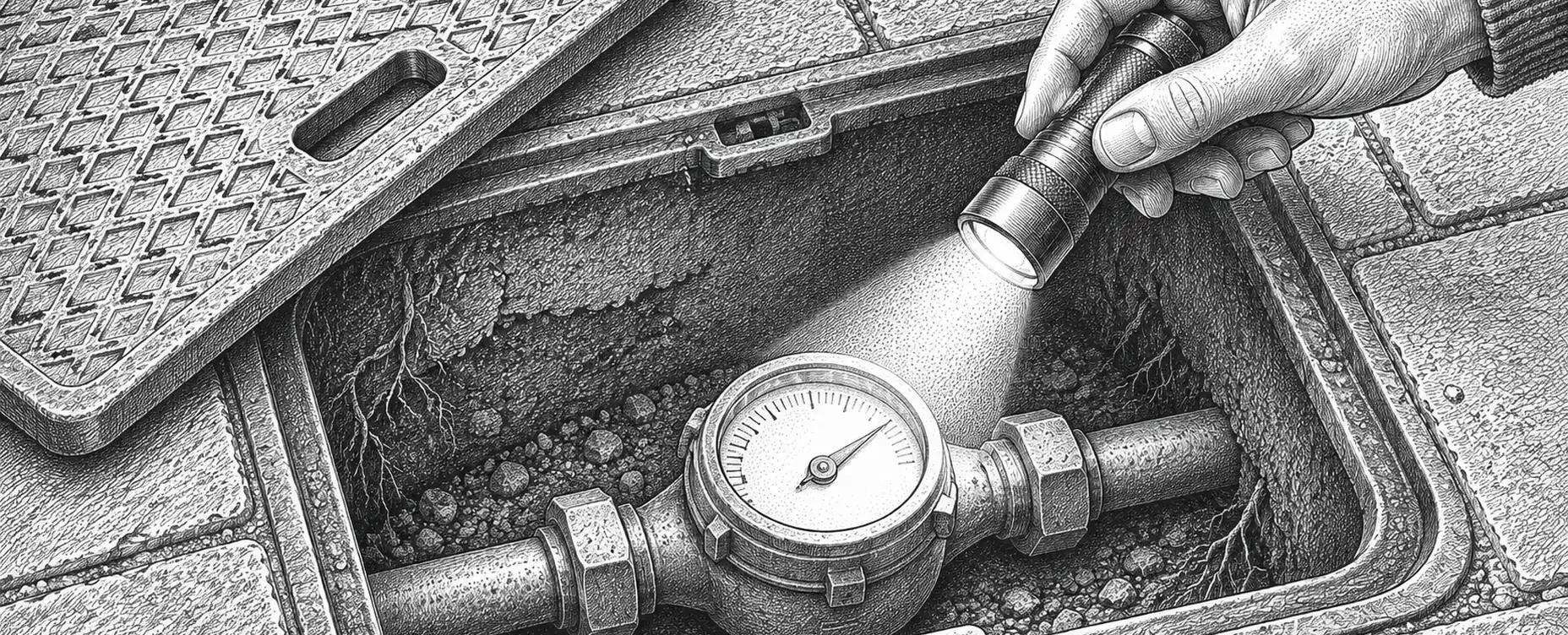
A remarkable number of households are paying for water they never use, and the leak is usually somewhere they will never look. The tool for finding it is already installed, free to use, and almost nobody knows how to read it properly.
Here is how to test your own system in twenty minutes, and what the readings tell you.
Understanding your meter
Most domestic meters record cubic metres — one cubic metre being 1,000 litres — on a row of digits, with smaller dials or digits after a decimal point for litres.
The important feature is usually a small spinning indicator: a star, a triangle or a tiny dial that rotates as water passes. It is far more sensitive than the digits, and it is the part that finds slow leaks. On a smart meter, the display may show instantaneous flow directly.
Find your meter first. It may be inside near the stopcock, in an external boundary box under a small cover in the pavement or driveway, or in a shared chamber for flats.
The twenty-minute leak test
This is the test worth knowing, and it is simple.
- Turn off everything that uses water. No taps, no appliances mid-cycle, no irrigation, and be aware of anything that fills automatically — an ice maker, a water softener regenerating, a heating system with an automatic filling loop.
- Note the exact meter reading, including the small dial position. Photograph it.
- Watch the spinning indicator for two minutes. If it moves at all, water is flowing somewhere and you have a leak. That alone is often enough.
- If it is not moving, wait longer. Leave the house untouched for two hours, or overnight if you can manage it, and compare the reading. Any increase is unaccounted-for use.
An overnight test is the most revealing, because it catches leaks too slow to see. Note the reading last thing at night, use no water, and read it again first thing. In a house with no leak the figure is identical.
Narrowing it down
Once you know water is going somewhere, isolation finds it.
Close the internal stopcock and watch the meter. Still moving? The leak is between the meter and the house — the supply pipe, often underground. Stopped? It is inside.
Inside, work through the likely culprits in order.
Toilets are the single most common cause. A worn flush valve or a badly set float can pass water continuously into the pan, silently, because the flow runs down the back of the bowl where it is invisible. The classic test: put a little food colouring in the cistern, do not flush, and check the pan twenty minutes later. Colour in the pan means the cistern is leaking, and a single failed toilet can waste hundreds of litres a day.
Dripping taps and mixer cartridges, which are visible and easy to underestimate — a steady drip amounts to a great deal over a month.
Outside taps and irrigation, particularly a buried line that fails without any surface sign.
Appliance fill valves passing slowly.
A heating system filling loop left open, which quietly tops up a leaking heating circuit and masks the real fault.
The supply pipe itself, which is the expensive one, and in many countries is the property owner's responsibility from the boundary inward.
Signs of a hidden leak
Beyond the meter, some symptoms point at water where it should not be.
A patch of ground or lawn that stays green or soft in dry weather, or a driveway that never quite dries. The sound of running water when nothing is on, especially audible at night. Unexplained damp low on a wall, or a musty smell in a cupboard. Pressure that has dropped gradually. A boiler or cylinder that fires more often than it used to, which can indicate a hot water leak. And in winter, an area of ground where frost or snow melts first, which is a reasonable indicator of a warm water leak below.
What the numbers mean
Some context for interpreting your usage.
Domestic consumption in Europe commonly falls somewhere around 100 to 150 litres per person per day, varying substantially by country, household and whether there is a garden. A rough split: showers and baths are usually the largest share, followed by toilets, then washing machines, then taps, with drinking water a tiny fraction of the total.
Useful reference points: a modern low-flush toilet uses around 4 to 6 litres per flush, an older one up to 13. A shower is typically 6 to 12 litres per minute, so an eight-minute shower can exceed a bath. A washing machine uses roughly 45 to 60 litres per cycle, a dishwasher 10 to 15 — which is why washing dishes by hand under a running tap uses considerably more.
Compare your daily total against your household size. Substantially above the range with no garden or pool suggests a leak rather than a habit.
Automating the monitoring
A one-off test finds a current leak. Continuous monitoring finds the next one.
Smart water meters supplied by your utility increasingly report daily or hourly consumption through a portal or an app, and some can be read locally. Check what yours offers, because the data may already exist.
Clip-on pulse readers attach to a meter with a pulse output or a magnetic register and report to your hub, giving you your own data regardless of the utility.
Inline flow sensors fitted after the stopcock give the finest resolution and can distinguish individual fixtures by their flow signature.
The alerts worth building: overnight consumption above a small threshold, which is the automated version of the overnight test and the single most useful rule; continuous flow beyond any plausible use; any flow while away; and daily total well above your normal.
That first rule is the one we would set up before any other. It runs the leak test for you every night, forever, and it will find a failing toilet valve within a day of it starting.
Reducing use, once you know it is not a leak
Genuinely useful measures, cheapest first: fix the dripping tap; fit aerators on taps, which reduce flow while feeling the same; a shower timer or a lower-flow head, since showers are usually the largest share; use the eco cycle on appliances, which uses less water as well as less energy; a cistern displacement device in an older high-volume toilet; and a butt for the garden, since outdoor use is the most seasonal and the easiest to substitute.
And measure before and after. Water use is one of the easier things to improve precisely because so much of it is habitual and invisible until it is counted.
Where to start
- Find your meter and learn to read the small indicator.
- Do the overnight test tonight.
- Do the food colouring test on every toilet in the house.
- Check for the hidden signs — green patches, running sounds, unexplained damp.
- Set up overnight consumption alerting so the test runs itself.
- Compare your daily use against household size before assuming you have a leak.
- Then reduce, starting with taps and showers.
Step three catches more leaks than any other single check in this article, and it costs the price of a bottle of food colouring.