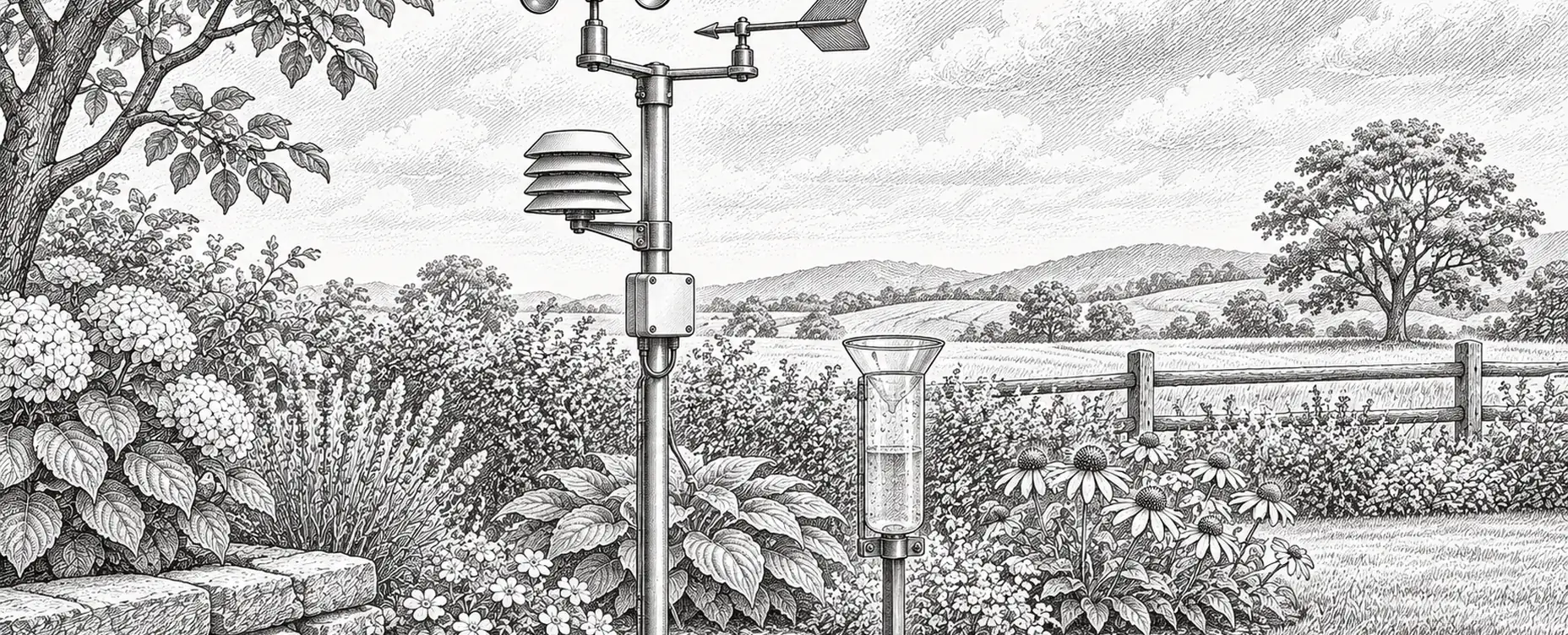
A home weather station is one of those purchases that can be either genuinely useful or an expensive source of numbers nobody looks at. The difference is whether the readings feed a decision.
Here is which measurements earn their place, how to site them so the figures mean something, and what to do with the data once you have it.
Which readings are worth having
In rough order of practical usefulness for a household.
Rainfall. The single most actionable reading, because it directly answers whether the garden needs water and by how much. A tipping-bucket gauge reporting millimetres beats any binary rain sensor.
Outdoor temperature. Feeds heating decisions, frost warnings, and the outdoor-versus-indoor comparison that drives sensible ventilation.
Outdoor humidity. Needed to compute absolute humidity and therefore to decide whether opening a window will dry the house or dampen it — which, as we cover elsewhere, is not the same as comparing relative humidity.
Wind speed and direction. Useful if you have an awning, a greenhouse vent, roof windows, or washing on a line. Also the reading most affected by poor siting.
Solar radiation and ultraviolet. Feeds evapotranspiration estimates for irrigation, and correlates with solar generation if you have panels.
Barometric pressure. Interesting, mildly predictive, rarely actionable at home. Falling pressure suggests unsettled weather; that is about as far as it goes.
Soil temperature and moisture. Genuinely useful for gardeners — soil temperature governs germination and when to plant far better than air temperature does.
Leaf wetness. Niche, and valuable if you manage fruit or vines, since many fungal diseases depend on how long foliage stays wet.
Siting, which matters more than the hardware
A well-sited cheap station gives more useful data than an expensive one on a wall in the sun. Meteorological convention exists for good reasons.
Temperature and humidity should be in shade, in a ventilated radiation shield, about 1.25 to 2 metres above ground, away from walls, paving and anything that stores heat. A sensor in direct sun can read several degrees high, and a sensor above a patio reads the patio.
The rain gauge wants an open position, roughly level, well clear of overhanging trees and ideally at least twice the height of nearby obstructions away from them. Under an eaves line it is worthless.
The anemometer should be as high and exposed as practical, conventionally 10 metres, which no domestic installation achieves. Above roof level is the realistic aim; in a sheltered yard the readings will be consistently and substantially low.
Solar sensors need a clear view of the sky with no shading through the day, and must be level.
Be honest with yourself about which of these you can achieve. A station on a fence in the lee of a house measures its own microclimate, which is fine for trends and not comparable with anything else.
All-in-one or separate sensors
All-in-one units put everything on one mast with one battery and one radio. Simple, cheaper, quicker, and they force a compromise: the position good for wind is rarely good for temperature.
Separate sensors let you site each one properly, which produces far better data and means more mounting, more batteries and more cost.
Our suggestion: if the data is for curiosity, all-in-one is fine. If it will drive irrigation or heating decisions, separate the temperature and humidity sensor at minimum, since that is the reading most corrupted by a compromise position and the one most automations depend on.
What to check before buying
Does it work locally? Some stations only report to a manufacturer's cloud, so your automations depend on an internet round trip and a service that may be withdrawn. A station that publishes on your local network is far more useful.
Can your hub read it? Check integration specifically rather than assuming, and prefer stations with an open local interface or a well-established integration.
Update interval. Once every 16 seconds and once every 15 minutes are very different for wind gust detection.
Are parts replaceable? Anemometer cups and bearings wear, rain gauge buckets break, ultraviolet sensors degrade. A station with spare parts available lasts a decade; one without lasts until the first failure.
Power arrangement. Solar with a battery buffer is the usual answer. Check the battery is replaceable and use lithium cells for the cold.
Heated rain gauge, if you want winter precipitation measured rather than a tipping bucket full of ice. Uncommon domestically and worth knowing you are missing.
Automations that actually use the data
This is the part that justifies the purchase.
Skip irrigation on measured rainfall, using a threshold in millimetres rather than a yes-or-no signal.
Ventilate on absolute humidity, comparing indoor and outdoor water content rather than relative figures. This is the automation that most reliably surprises people, because cold damp outdoor air genuinely dries a house.
Retract the awning on wind. A gust threshold protecting an expensive awning pays for a station on its own. Same for roof windows and greenhouse vents.
Frost warning. Alert below 2 °C so you can cover tender planting, and use soil temperature rather than air for a genuine ground frost.
Close windows on rain. Obvious, and it needs a rain sensor that responds in seconds rather than a gauge that reports in tips.
Pre-cool before a hot day, using the forecast maximum, and ventilate overnight when the outdoor temperature drops below indoors.
Soil temperature planting prompts. Many seeds have a known minimum soil temperature, and a sensor answers it far better than the calendar.
Correlate solar generation with radiation, which lets you spot a shaded or failing panel string, since output that no longer tracks radiation the way it used to is a fault signal.
Sharing your data, if you want to
Several volunteer networks aggregate amateur weather station data and use it for forecasting research, local reporting and hyperlocal forecast improvement. Contributing is free, gives you a public page and some validation of your readings, and improves data density where official stations are sparse.
Two things to consider first. Siting quality matters if the data is going to be used by others, so be honest in the metadata about how compromised your position is. And a public station page reveals a location, which is worth thinking about before publishing your exact coordinates.
Where we would start
- Buy a rain gauge first, even a manual one. It is the reading that changes decisions most.
- Add a shaded outdoor temperature and humidity sensor, sited properly, on a mesh protocol your hub already speaks.
- Build the absolute humidity ventilation rule. This alone justifies the sensors.
- Add wind only if you have something to protect — awning, roof windows, greenhouse.
- Add soil temperature and moisture if you grow anything seriously.
- Add solar radiation if you irrigate on evapotranspiration or want to monitor panels.
- Check every reading against reality in the first month — a thermometer in the shade, a jam jar beside the rain gauge. Calibration errors are common and easy to spot early.
Step seven is the one people skip and regret. A station reporting confidently wrong figures is worse than no station, because you will build automations on it.