Fire safety beyond alarms: the part that decides the outcome
Smoke alarms tell you a fire has started. What decides whether it matters happens before and after that moment: detection, escape and prevention.
Smoke alarms tell you a fire has started. What decides whether it matters happens before and after that moment: detection, escape and prevention.
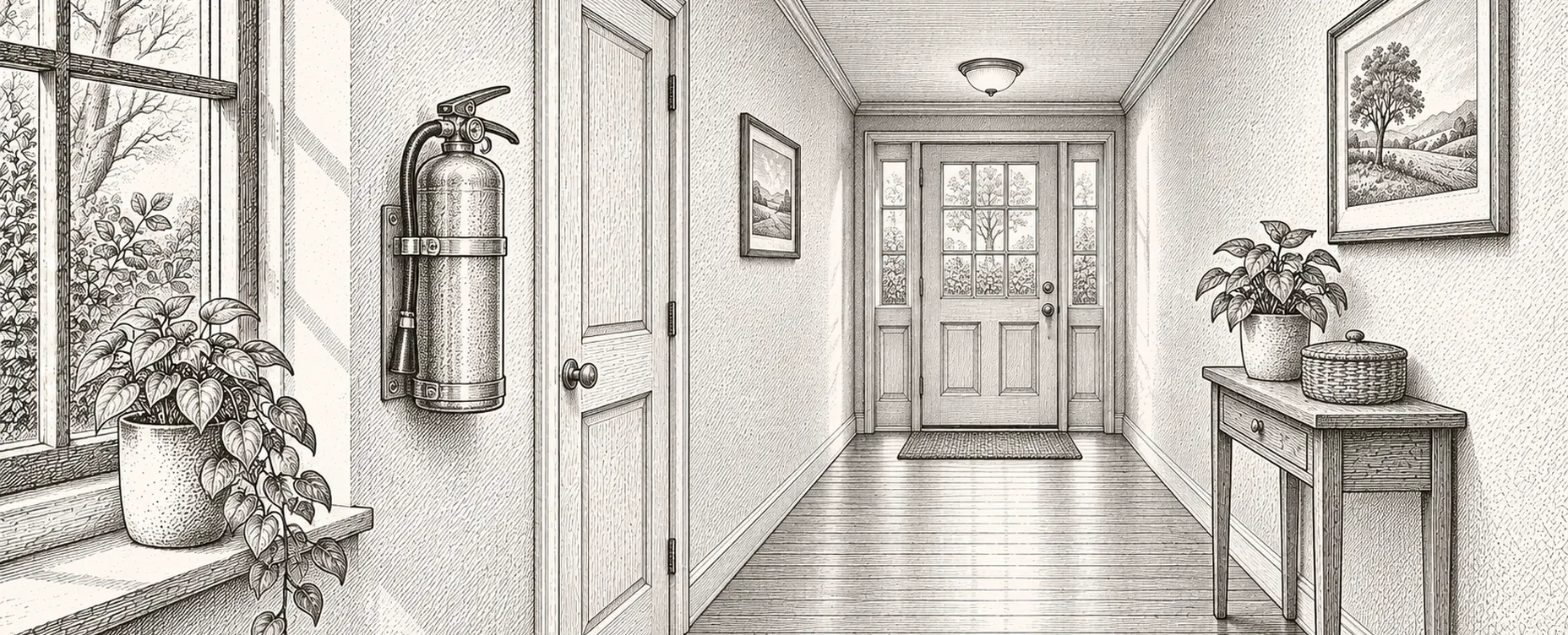
Alarms tell you a fire has started. Everything that determines whether it matters happens before and after that moment — what is in the house that could start one, and whether everybody gets out.
This is the least technological article on this site and the one we would most want people to read. Automation has a small supporting role and the important measures are ordinary.
Fire services in every country give the same advice, and it is worth repeating because households rarely do it.
Decide your escape route, and a second one in case the first is blocked. Walk it.
Keep it clear. A hallway with bicycles, a landing with boxes, a back door blocked by a chest freezer. Escape routes accumulate obstacles quietly.
Keep keys where you can find them in the dark. A door that needs a key you cannot find is a locked door. This is a specific and repeated cause of deaths, and it is one reason to think carefully about locks that need a key from the inside.
Agree a meeting point outside.
Tell everyone the plan, including children, and practise it once. Ten minutes, once a year.
The core message is that you get out and stay out. You do not gather possessions, you do not go back in, and you call the fire service from outside. Modern furnishings burn fast and produce smoke that incapacitates within a couple of breaths, which is why the timescales are much shorter than people imagine.
The single most effective free thing in this article.
A closed internal door holds back smoke and heat substantially, and the difference in survivable time on the other side is large. Fire services run campaigns on exactly this point.
So: bedroom doors closed at night, and the kitchen and living room doors closed too, since that is where most fires start. If a member of the household needs a door open for reassurance, a closed door with a monitor or an intercom is a reasonable compromise.
This is worth knowing when thinking about ventilation and air quality, which push in the opposite direction. The resolution is a closed door with deliberate ventilation — a trickle vent, a window on a vent setting, or mechanical ventilation — rather than an open door.
Fires from electrical faults are among the most frequent, and most are preventable.
Overloaded sockets and daisy-chained extension leads. A four-way adaptor plugged into another four-way, with a heater and a kettle on it, is how sockets catch fire. Count the total load, not the number of holes.
Damaged or coiled cables. A cable coiled tightly while carrying significant current gets hot. So does one trapped under a rug or run under a carpet.
Cheap unbranded chargers and power supplies. This is a genuine and well-documented problem, and the counterfeit market is substantial. Buy from reputable sources, and be particularly careful with anything charging a lithium battery.
Lithium batteries. Increasingly the significant new risk, and worth its own paragraph. Damaged, swollen or punctured cells, cheap replacement batteries, and charging with the wrong charger are the main causes. Fire services in several countries have reported sharp rises in fires from e-bike and e-scooter batteries specifically. Practical measures: charge on a hard non-combustible surface, not overnight while asleep, not in a hallway or escape route, never a swollen battery, and use the manufacturer's charger.
Tumble dryer lint, which is the most common appliance fire factor and entirely a maintenance issue.
Older consumer units and wiring. If your installation has not been inspected in a decade or more, a periodic inspection is worth having, and in rented property it is generally a legal requirement.
Unattended cooking is the leading cause of domestic fires almost everywhere.
Do not leave a hob unattended, particularly with oil. Take the pan off the heat if you must leave the room.
Know how to deal with a pan fire: turn off the heat if you safely can, cover with a fire blanket or a close-fitting lid, and never use water. Water on hot oil produces a violent steam explosion and is a common cause of serious burns.
Keep a fire blanket within reach, not in a cupboard behind the crockery.
Use a heat alarm in the kitchen, not a smoke alarm, so nuisance alarms do not get it disabled.
Be careful with deep frying, and prefer a thermostatically controlled fryer to a pan of oil.
The one genuinely useful automation here: an alert if the hob has been drawing power for an unusually long time. It catches the pan somebody forgot, which is exactly the scenario that causes harm.
Domestic extinguishers are less useful than people assume, and fire services are cautious about recommending them.
The reasons: they hold very little, they require the correct type for the fire, they require you to stay in a room that is filling with smoke, and using one delays evacuation. A small extinguisher used confidently on a small fire in its first moments is useful; anything beyond that is not what they are for.
If you keep one, keep a multi-purpose dry powder or foam type for general use, know that powder is unpleasant indoors and makes a considerable mess, and never use water or foam on electrical equipment or cooking oil.
A fire blanket is more useful in a domestic kitchen than any extinguisher, and much cheaper.
And the rule that overrides all of it: if the fire is bigger than a waste bin, leave.
Modest but real, and worth setting up.
Notification when you are out, so a fire in an empty house is not discovered by a neighbour.
Lighting the escape route at full brightness on a confirmed alarm. In a smoke-filled house at 3am this is genuinely useful.
Stopping mechanical ventilation so it does not distribute smoke.
Unlocking a smart lock on the escape route, which on balance we think is right in most households.
Shutting off a gas supply, if you have an appropriate valve fitted.
Identifying which alarm triggered, which informs whether you investigate or evacuate.
Hob duration alerts and dryer run-hour reminders.
What automation cannot do: replace a closed door, a clear hallway, a found key or a working alarm. Those are the things that determine outcomes.
None of that costs anything and all of it matters more than any device on this website.