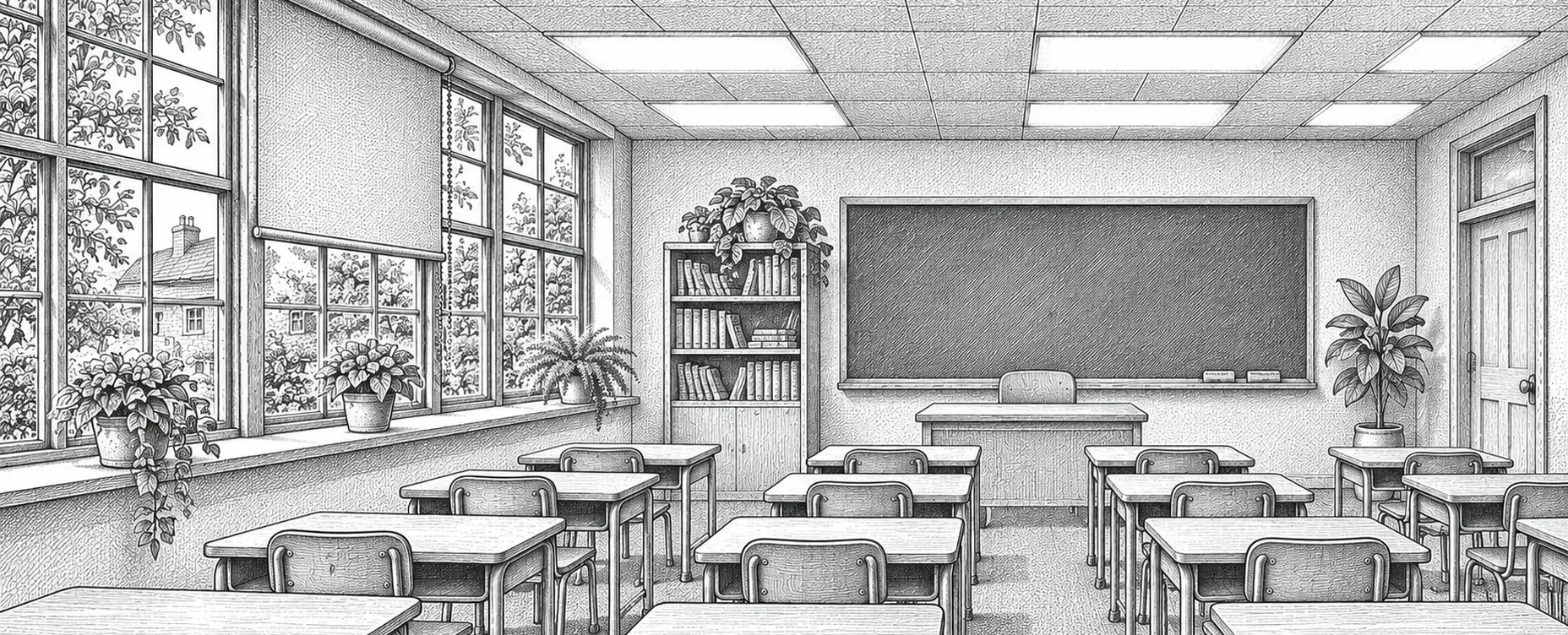
Lighting is the least discussed and most universal problem in school buildings. Almost every classroom is lit to a level and quality decided decades ago by whatever fittings were cheapest, and almost nobody has measured whether it is adequate for the children now working under it.
It is also the easiest thing in this whole category to improve, because the technology is mature, the payback on efficiency is short, and the effect on how a room feels is immediate.
Three things to get right
How much light
Illuminance is measured in lux. National standards for educational buildings typically specify something in the region of 300 lux on a classroom desk, with higher figures for detailed work such as technology workshops and art rooms, and specific requirements for whiteboards and teaching walls. Find your own national or European standard and use it rather than a number from an article — the figures differ and they are frequently a compliance matter.
What is worth knowing is that many older classrooms fall well short, particularly at the back of the room and on dull days, and that the shortfall is invisible to occupants because eyes adapt. A cheap lux meter or a phone app used as a rough guide will usually surprise you.
Glare and distribution
More light is not automatically better. Glare from a bright fitting in the field of view, or reflections on a screen or whiteboard, cause more complaints than low light levels. Even distribution matters too: a room that is bright at the front and dim at the back is a common consequence of fittings arranged for a layout nobody uses any more.
Colour quality
Two numbers. Colour temperature, in Kelvin, describes how warm or cold the white looks — classrooms typically use around 4,000 K, a neutral white. Colour rendering (CRI) describes how truthfully colours appear; above 80 is generally required and above 90 is worth having in art rooms and science labs where colour matters for the work itself.
What automation actually adds
Replacing old fittings with efficient LED ones is an energy project with a straightforward payback. Control is what turns it into something better.
Daylight dimming
The most valuable control in a school. A lux sensor measures the light already arriving through the window and dims the electric lighting to maintain the target level. On a bright day a classroom with good glazing may need almost no artificial light, and dimming rather than switching keeps the level constant so nobody notices anything except that the room is comfortable.
This saves meaningfully more than occupancy control in daytime-occupied buildings, because schools are used exactly when daylight is available.
Occupancy control
Worth having, with two cautions. Use presence detection rather than simple motion in rooms where people sit still, and use generous timeouts. A classroom that goes dark during a test because thirty children were writing quietly is the fastest way to have the whole system disabled.
Corridors, toilets, stores, changing rooms and offices are where occupancy control pays best, because they are genuinely intermittently used and nobody sits still in them.
Scheduling and out-of-hours
A schedule that switches everything off after the building empties, with local override for evening lettings and cleaning, catches the lights left on all weekend in a block nobody visited.
What about circadian or “human-centric” lighting?
Systems that vary colour temperature through the day — cooler in the morning, warmer in the afternoon — are marketed heavily to schools with claims about alertness and behaviour.
The underlying science is real: light exposure, particularly blue-rich light in the morning, influences circadian rhythm and alertness. The claims made for classroom installations are considerably stronger than the evidence supports. Studies exist, several are small, some are industry-funded, and results are mixed. We would not spend a constrained budget on tunable-white lighting before the basics — adequate level, controlled glare, daylight dimming — are done, and we would treat confident claims about attainment with scepticism.
If you do want it, the strongest case is in windowless internal rooms where occupants get very little daylight, rather than in a classroom with a wall of south-facing glazing.
The rooms that get forgotten
Attention naturally goes to classrooms, and several other spaces are worse and cheaper to fix.
Corridors and stairwells are frequently over-lit and lit continuously, including through holidays. They are also the easiest place to apply occupancy control without anyone objecting, because nobody sits still in a corridor.
Toilets are almost always lit all day regardless of use, and are an obvious candidate for presence control with a modest timeout.
Stores, plant rooms and cleaners’ cupboards are the classic sites of a light left on for weeks. A simple occupancy sensor pays for itself and nobody notices it exists.
Staff rooms and offices follow office rather than classroom logic: presence detection, daylight dimming where there is a window, and an out-of-hours schedule.
Between them these spaces often account for a surprising share of a school’s lighting energy, and none of the interventions requires a conversation with a teacher about a classroom going dark.
Practical constraints
Wiring dictates a lot. Many school lighting circuits have no neutral at the switch, or are wired so a whole corridor is one circuit. Retrofitting control frequently means working in the ceiling or at the distribution board, which is holiday work and an electrician's job.
DALI is common and useful. Commercial lighting in newer school buildings often uses DALI, an addressable lighting standard that allows individual fittings to be dimmed and monitored. If your building has it, that is an asset — a gateway exposes it to modern control far more cheaply than rewiring.
Sports halls and specialist spaces differ. High-bay lighting in a sports hall, blackout requirements in a drama studio, and specific levels in workshops all need designing rather than standardising.
Robustness matters. Sensors and switches within reach will be interfered with. Mount high, choose commercial hardware.
Where to start
- Measure the illuminance in a sample of rooms, at desk level, at the back as well as the front, on a dull day. Compare with your national standard.
- Fix the rooms that fall short, and the rooms with glare complaints, as a lighting quality project rather than an automation one.
- LED replacement where old fittings remain, which pays back on energy alone.
- Daylight dimming in daylit teaching spaces — the highest-value control in a school.
- Occupancy control in corridors, toilets, stores and offices, with presence detection and generous timeouts in any room where people sit.
- An out-of-hours schedule with local override for lettings and cleaning.
- Leave tunable white until last, and only where daylight is genuinely absent.
The order is deliberate: get the light right first, then make it efficient, then make it automatic. Automating inadequate lighting simply means it is inadequate on a schedule.