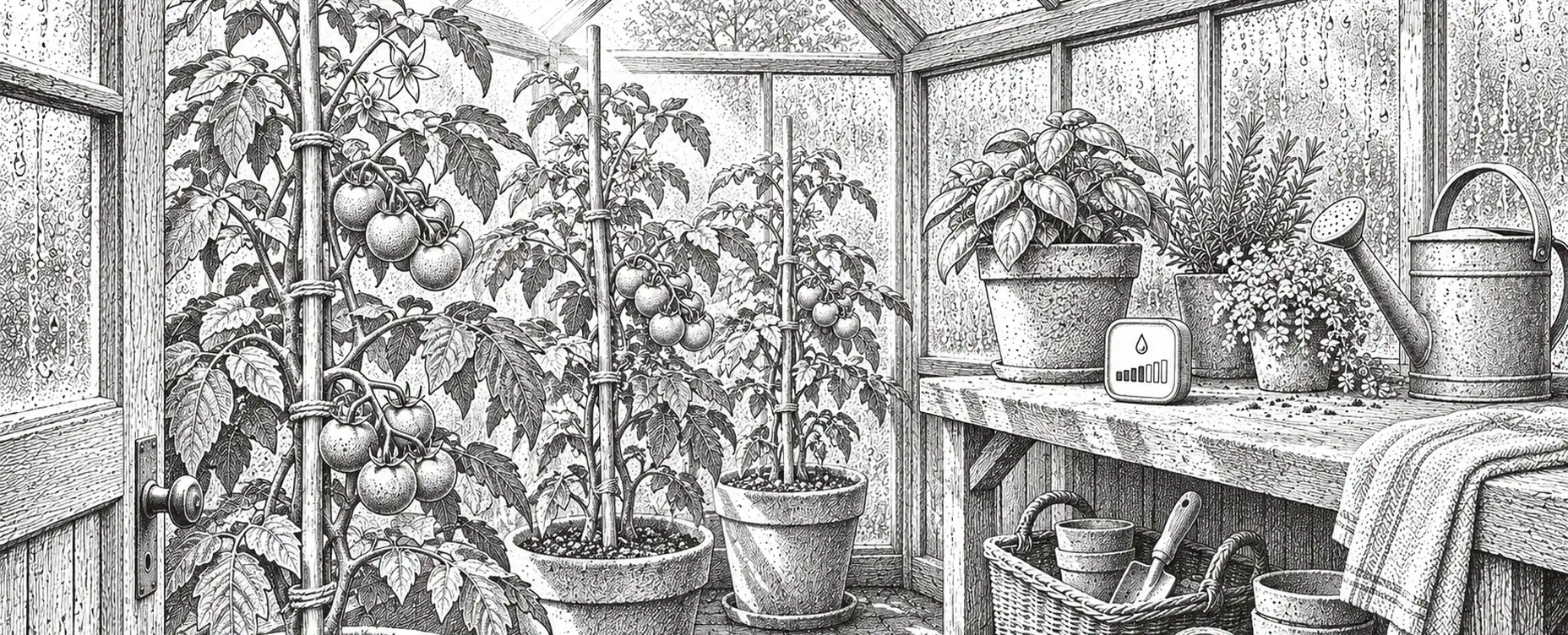
A greenhouse is the most rewarding place in a garden to put sensors, because the conditions inside change fast, the consequences of getting them wrong are visible within days, and the interventions are simple enough to automate reliably.
It is also the place where people most often buy equipment before understanding the problem. Here is what is worth measuring, what the plants actually need, and which automations do real work.
The problem a greenhouse creates
Glass admits shortwave solar radiation and traps the longwave heat radiated by warmed surfaces inside. That is the point in March and the problem in July.
An unventilated greenhouse in summer sun can exceed 45 °C within an hour, which is lethal to most plants. The same structure at night in April can be barely warmer than outside, because glass is a poor insulator and all the day's stored heat escapes.
So the two jobs are shedding heat in summer and retaining it in spring and autumn, and both are largely about air movement rather than heating.
What to measure
Air temperature, in shade, at plant height rather than at the apex. A sensor in the roof reads the hottest air in the structure and misses what the plants experience; a sensor in direct sun reads several degrees high. Use a small radiation shield or tuck it under a bench edge with airflow.
Humidity. High humidity plus still air is the recipe for botrytis and mildew, which is why ventilation matters even when the temperature is fine. Aim broadly for 50 to 70 per cent for most crops, and lower for anything prone to fungal disease.
Soil or growing-medium moisture, at root depth. In pots, this is the reading that prevents both under-watering and the far more common problem of over-watering.
Soil temperature. Germination is governed by soil temperature, not air temperature, and it lags behind. Most seed has a documented minimum, and a probe answers “is it time?” far better than the calendar.
Minimum overnight temperature. The single figure that decides whether tender plants survive, and the one worth logging and alerting on.
Light levels, if you are serious. Useful for judging shading and whether supplementary light is doing anything.
Vent and door position, so you know the state of the structure rather than inferring it.
Ventilation: the highest-value automation in a greenhouse
If you automate one thing, automate this. Manual venting fails on exactly the days it matters — a hot morning while you are at work, a sudden change while you are away.
Automatic vent openers using a wax cylinder need no power, no electronics and no network. They expand as temperature rises and push the vent open. They are crude, adjustable only roughly, and completely reliable, and for a small greenhouse they may be all you need. We would fit these regardless of what else you install, as a fallback.
Powered vents and louvres, controlled by your hub, give proper control: open in stages, respond to humidity as well as temperature, close on wind, close at dusk to retain heat.
Extraction fans move far more air than passive vents on a still day, and a fan plus a low intake louvre creates cross-flow, which is what actually cools.
Internal circulation fans are underrated. Gentle constant air movement reduces fungal disease markedly by preventing still humid pockets around foliage, and it strengthens stems. This is a cheap intervention with a disproportionate effect on plant health.
The rule set worth building: open progressively above a target temperature, add extraction above a higher one, open on high humidity even when cool, close on strong wind to protect the vents, and close in the late afternoon in spring to bank heat for the night.
Shading and heating
Shading is more effective than ventilation for extreme heat, because it stops the energy arriving. Shade netting, whitewash or automated blinds all work; the modern option is a blind on the sunny side triggered by light level or temperature. Note that shading reduces growth as well as heat, so it should come on when needed rather than staying up all summer.
Heating is where costs escalate quickly, and the honest advice is to heat as little space as possible.
A heated propagator or bench keeps a small volume of growing medium warm for a fraction of the cost of heating a whole greenhouse, and germination is what usually needs the warmth. A frost-protection setpoint of 3 to 5 °C, rather than a growing temperature, protects overwintering plants cheaply. Bubble wrap or horticultural fleece lining improves insulation dramatically for very little, at the cost of some light.
And measure it. A greenhouse heater on a thermostat you have never verified can run far more than you assume; a plug with energy monitoring tells you in a week.
Watering under glass
Greenhouse watering is unforgiving because pots dry out fast in heat and there is no rain.
Drip lines with individual emitters to each pot or grow bag are the right answer, delivering water at the roots with minimal loss and no wet foliage — which matters, since wet leaves in a humid greenhouse invite disease.
Capillary matting on benches suits seedlings and reduces the frequency of intervention.
Water in the morning, so foliage and surfaces dry during the day.
Trigger on soil moisture rather than a timer, because demand varies hugely between a cool cloudy week and a heatwave, and a fixed schedule is wrong in both.
Use a butt and a pump where you can. Rainwater is preferred by most plants, and a level sensor lets you fall back to mains automatically.
One warning: an irrigation failure in a greenhouse in summer kills plants within a day or two, far faster than in the garden. Flow monitoring and a failure alert matter more here than anywhere else in the garden.
Alerts worth setting up
- Temperature above 35 °C — something has failed, probably a vent.
- Temperature below 2 °C — frost risk to tender plants.
- Humidity above 85 per cent for a sustained period — disease risk.
- Soil moisture below target after an irrigation cycle should have run — the system did not deliver.
- Mains power lost, which silently ends heating, ventilation and watering at once.
- Door left open overnight in spring, which wastes the day's banked heat.
Grow lights, briefly and honestly
Supplementary lighting works, and it is easy to spend a lot on it for little benefit in a domestic greenhouse.
Two points matter. Plants respond to photosynthetically active radiation — the wavelengths they can actually use — so lumens, which describe human perception, are the wrong unit; look for figures in micromoles per square metre per second. And day length matters as much as intensity for many plants, which means a modest light on a long schedule often beats a powerful one on a short one.
For seed raising in late winter, a modest LED panel on a timer over a propagator is genuinely useful and prevents the leggy, drawn seedlings that low light produces. For growing summer crops, daylight is free and vastly more powerful than anything you will install.
A starting set-up
- A wax-cylinder automatic vent opener as a no-power fallback, whatever else you do.
- Temperature and humidity at plant height, shaded, logged.
- A soil temperature probe in a representative pot or bed.
- Powered vent or extraction with rules on temperature, humidity and wind.
- A small circulation fan running gently for most of the day.
- Drip irrigation on soil moisture, watering in the morning, with a failure alert.
- Bubble insulation and a frost setpoint instead of heating for growth.
- The alert list above.
Items one and five are the cheapest and among the most effective, and the circulation fan is the one experienced growers add and beginners never think of.