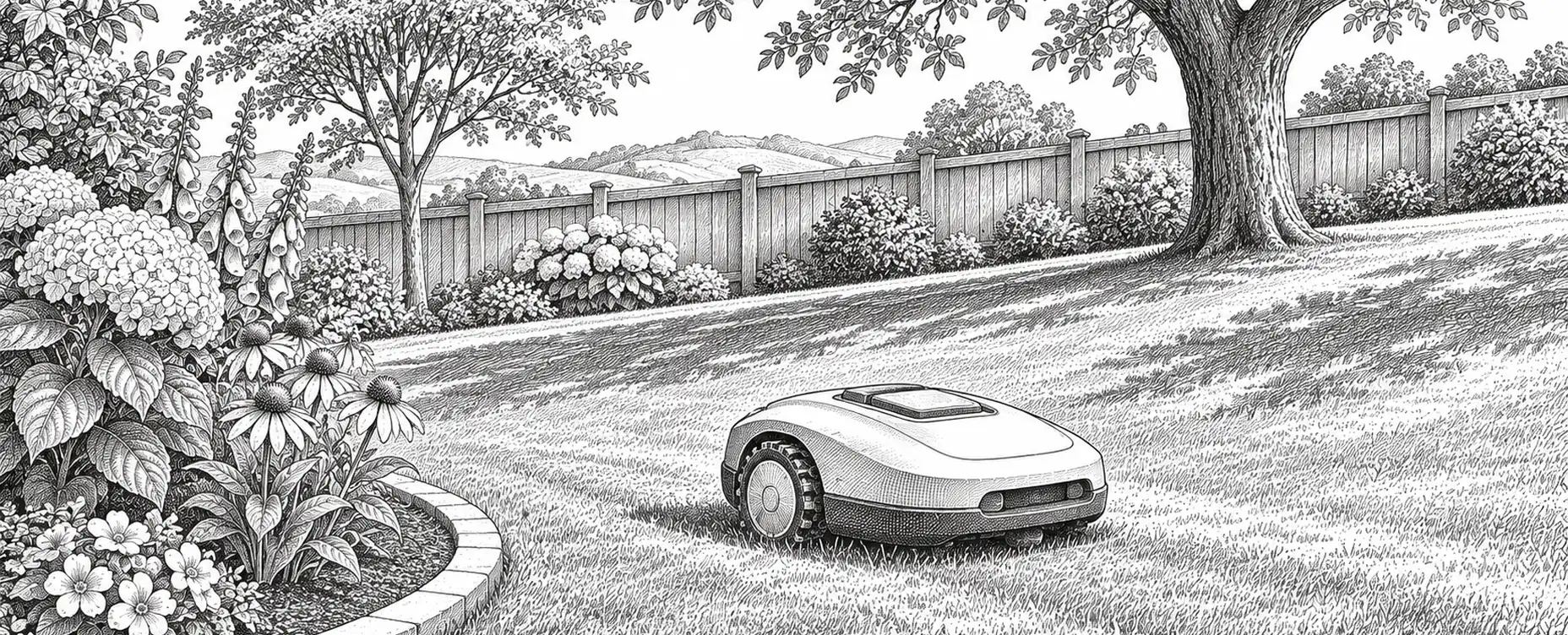
Robot mowers have gone from curiosity to commonplace, and they are one of the few garden devices that genuinely change the work involved. A lawn cut a little every day, all season, looks better than one cut hard every fortnight, and it requires nothing from you.
They also fail in predictable ways, and they carry safety considerations that deserve stating plainly. Here is what determines whether one works in your garden.
Why frequent light cutting works better
The horticulture matters, because it explains the whole approach.
Grass grows from the base, and removing a large proportion of the leaf at once stresses the plant — the traditional guidance is never to remove more than a third of the height. A fortnightly cut on vigorous spring growth breaks that rule badly, which is why a lawn often looks pale and ragged afterwards.
A robot removes a few millimetres daily. The clippings are tiny, fall between the blades and decompose within a day or two, returning nitrogen to the soil — this is mulching, and over a season it measurably reduces the need for feeding. The grass responds by thickening and growing more laterally, which crowds out moss and some weeds.
Two honest consequences. There are no clippings to collect, which most people consider a benefit. And you cannot get stripes, because there is no roller and no consistent direction — if a striped lawn is what you want, a robot is the wrong tool.
Boundary systems: the choice that decides installation
Perimeter wire is the established approach. A thin wire is pegged or buried around the lawn and around any obstacle, and the mower detects the signal. It is reliable, cheap, works under trees and in poor satellite conditions, and it is a real afternoon's work to install — more if your garden is complicated. Wires get cut by spades and chewed by animals, and repairs are fiddly.
Satellite navigation with a reference station uses precise positioning to follow a boundary you define in an app, with no wire at all. Setup is far quicker, boundaries are easy to change, and it needs a reasonably clear view of the sky — performance under dense tree cover or between tall buildings is poorer, and some models fall back to random behaviour when they lose position.
Vision-based systems use cameras to recognise grass and obstacles. Promising, and the most variable in practice.
Our reading: for a small, enclosed, tree-shaded garden, wire remains the more dependable choice. For a larger open lawn, or one you expect to reconfigure, satellite navigation is worth the premium and saves the installation day.
Sizing and terrain
Match the area rating generously. Manufacturers quote a maximum lawn area assuming near-continuous operation in good conditions. A mower rated exactly for your lawn will struggle in a wet spring and after a week of rain when everything grew.
Check the slope rating, quoted as a percentage. A 35 per cent slope is around 19 degrees, which is steeper than it sounds. Mowers slip on wet grass on slopes, and a slope at the boundary is where they get stuck or run over the edge.
Narrow passages matter. A garden in two parts connected by a metre-wide path needs a mower that can find and follow it, and wire systems handle this with a guide wire. Some gardens simply need two mowers or one moved by hand.
Lawn edges. No robot cuts a clean edge against a wall or a bed, because the blade sits inboard of the wheels. Expect to trim edges occasionally, or install a mowing strip — a flush paved border the mower can drive on — which is the proper solution and transforms the result.
Obstacles. Trampolines, garden furniture, dog toys, fallen fruit and molehills all cause stoppages. Fewer objects on the lawn means fewer rescues.
Safety, which needs stating clearly
These are machines with rotating blades operating unattended in a space where children and animals play.
Modern mowers are designed with this in mind: lift and tilt sensors stop the blades within a fraction of a second, blades are small and pivoting rather than rigid, and the cutting height keeps them well above ground level. Products sold in the EU must meet the relevant machinery and safety standards, and reputable brands take this seriously.
That said, there are documented injuries, mostly to hands and feet reaching under a running machine, and mostly involving children. There is also a well-documented ecological issue: robot mowers injure hedgehogs, which curl rather than flee, and they harm frogs, toads and slow worms. Studies and wildlife organisations have raised this specifically.
Sensible practice, and it costs nothing:
Do not run it at night or at dusk, which is when hedgehogs and amphibians are active. Daytime operation eliminates most of the wildlife risk.
Do not run it when children or pets are on the lawn. Link it to occupancy if you can.
Walk the lawn first, especially in autumn when animals shelter under leaves.
Set a PIN so it cannot be started or carried off casually.
Keep the blades sharp and replaced, since blunt blades tear grass and load the motor.
Automation worth adding
Most mowers have their own scheduling. Integrating with a home system adds the conditions the mower cannot see.
Skip mowing after significant rain, using a rain gauge figure rather than a rain sensor. Wet grass clogs, slips on slopes and marks a soft lawn.
Do not mow when the garden is occupied, from a door contact or a presence sensor.
Pause during outdoor entertaining, which is a scene rather than a schedule.
Daylight-only windows that follow sunrise and sunset rather than fixed clock times, so the season is handled automatically.
Alert on stuck or stopped, which is the genuinely useful one. A mower that stopped on Tuesday and sat under a shrub until Friday has cut nothing.
Alert on failure to return to dock, and on unexpected movement outside operating hours, which is your theft signal.
Reduce frequency in high summer, when growth slows in dry weather and cutting a stressed lawn short does harm. Linking cutting frequency loosely to rainfall is the sophisticated version.
Winter reminder to clean it, charge the battery and bring it indoors, since lithium batteries do not enjoy a cold shed.
What we would do
- Choose the boundary system for your garden: wire for small and shaded, satellite for large and open.
- Size up, not exactly, and check the slope rating against your worst bank.
- Install a mowing strip where you can, which fixes the edge problem permanently.
- Set daylight-only operation following sunrise and sunset.
- Add a rain skip based on measured rainfall.
- Add the stuck alert, which is the difference between a cut lawn and a mower under a bush.
- Walk the lawn before autumn runs, and clear objects habitually.
- Set a PIN and bring it in for winter.
Items four and six are the two that most change the experience: one for the wildlife and your peace of mind, the other because a robot mower's real failure mode is not breaking down, it is quietly stopping.